Beef Share or Buying by the Cut?
The real trade is not price against quality. It is price against choice, and the honest answer depends on how you actually cook.
This is the decision most people are actually making, and the usual framing of it is wrong. It is not cheap against good. Both are the same beef.
What a share gives you
- A lower price per pound. About $17 a pound on a half share against buying the same cuts separately. The arithmetic is in cost per pound.
- Variety you would not have chosen. Roasts, bones, the slower cuts. Most people count this as a benefit after about three months and a nuisance in the first week.
- One decision instead of forty. You stop thinking about buying beef for a year.
What it costs you
- Freezer space. About 175 lbs needs a chest freezer of its own. This is the constraint that actually decides it.
- Money up front. $3,000 at once rather than spread across a year.
- Control. You get the animal's mix, not your preferences. Ground beef is the largest part by weight and steaks are the smallest, which is set out in what you get in a half share.
“And I think people enjoy kind of getting to figure out what am I supposed to do with a sirloin tip? What am I supposed to do with a picanha or a tri-tip? I get to go learn and experiment in the kitchen some and figure out how to cook something.”
Gray Shipley
Who should buy by the cut
Households that eat beef once or twice a week, that have a normal freezer, or that only really want steak. There is nothing wrong with this and we sell plenty of boxes to people who have thought about it and decided. If steak four nights a week is your pattern, a share is the wrong purchase.
Who should buy a share
Households that cook most nights, that have or will buy a chest freezer, and that are willing to learn a few cuts they have not cooked before. That last one is the real test, and it is also the part people end up enjoying.
“I like to go with something a little more economical. And so either something like a chuck roast or a sirloin tip, maybe in the crock pot or some short ribs this time of year. Or, I like taking out maybe some skirt steak, some fajita meat, and making some tacos, making some fajitas, getting something that you can just kind of chop up and mix up whatever.”
Gray Shipley
“I like to sell the filets and the ribeyes and then eat the more lesser-known secondary cuts myself.”
Gray Shipley
If you have never bought from us at all, neither is the right first move: see which cut should you buy first.
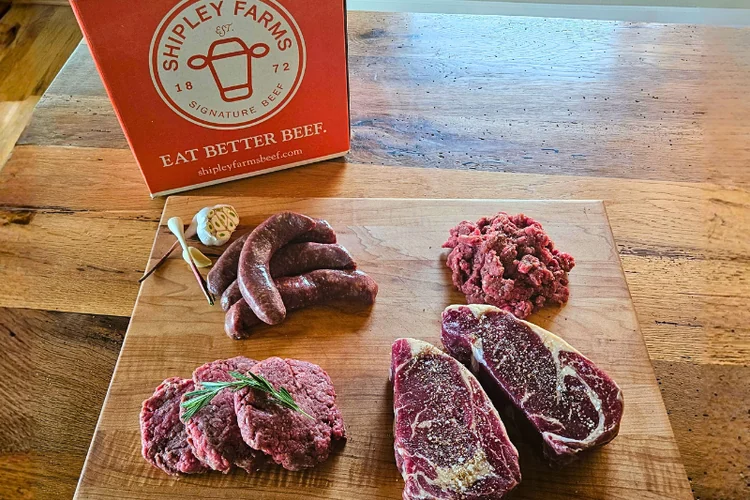
Exactly what you want, at a higher price per pound.
View ProductShould I buy a beef share or just buy the cuts I want?
A share is cheaper per pound and forces variety; buying by the cut costs more and lets you choose.
- Freezing and Food Safety, USDA FSIS
Food-safety temperatures and storage times on this page are cited to the agencies above rather than to us.
Written at Shipley Farms in Vilas, North Carolina: a family cattle farm raising and dry-aging beef in the Appalachian Mountains, now in its fifth generation. No shortcuts since 1872.
Every quote on this page is Gray Shipley talking, the man who runs this farm. We sat down with him, turned on a recorder, and kept his own words. Hesitations are trimmed so they read on the page. Nothing else is added or reworded, except where Gray revised his own words in review.
Nobody knows this beef better than we do. On food safety we leave it to USDA FSIS, and we have linked their page above. Reviewed 3 October 2026.
Shipley Farms
Stories, recipes and news from Shipley Farms.