How a Beef Share Works, Start to Finish
People order a share and then are not sure what happens next. Here is every step, in order, and roughly how long each takes.
Buying a share is not like buying a steak. You are reserving part of a specific animal, and that changes the sequence. Here is the whole thing.
- Pick a size. Eighth, quarter, half or whole. Decide on freezer space first, which is the argument in which share is right for you.
- Reserve it. Shares are reserved rather than stocked. For a whole beef or a side that means a deposit, with the balance billed on hanging weight later.
- We match you to an animal. This is the step with no equivalent in normal shopping, and it is why we ask you to commit before you collect.
- Cut sheet. For a whole or half you choose thickness, roast sizes, what becomes ground, and whether you want the bones and fat. Set out in how to read a cut sheet.
- Harvest, hang and cut. Dry-aging happens here if you chose it, and it takes weeks rather than days.
- Pack and freeze. Everything is vacuum-sealed and frozen hard before it goes anywhere.
- Collect. You get a date. Bring coolers and clear the freezer first.
“Because it's tough for smaller farmers to have something available, 200 pounds ready to go. And we don't know whether you're coming or not. Because if you're not coming, then we still have to find a home for it. And if you are, we have to have it ready.”
Gray Shipley
Why we need to know you are coming
That is the honest mechanics of it. An animal is a fixed quantity that exists whether or not you turn up, so a share that is reserved and then abandoned is a real problem rather than an inconvenience.
“And it takes three years to make a steak.”
Gray Shipley
Three years from calf to steak. Nothing in that sequence can be hurried at the end because somebody ordered late.
How long the whole thing takes
From reserving to collecting is usually weeks rather than days, and longer if you chose dry-aged, because the aging is real time in cold storage. If you need beef this week, buy a box instead; a share is a plan, not a purchase.
What to do on collection day
- Clear and measure the freezer before you drive over. A half share is about 175 lbs.
- Bring coolers or boxes. It is packed frozen and you want it to stay that way.
- Set up the freezer first, which is covered in how to fill a freezer.
“And I think people enjoy kind of getting to figure out what am I supposed to do with a sirloin tip? What am I supposed to do with a picanha or a tri-tip? I get to go learn and experiment in the kitchen some and figure out how to cook something.”
Gray Shipley
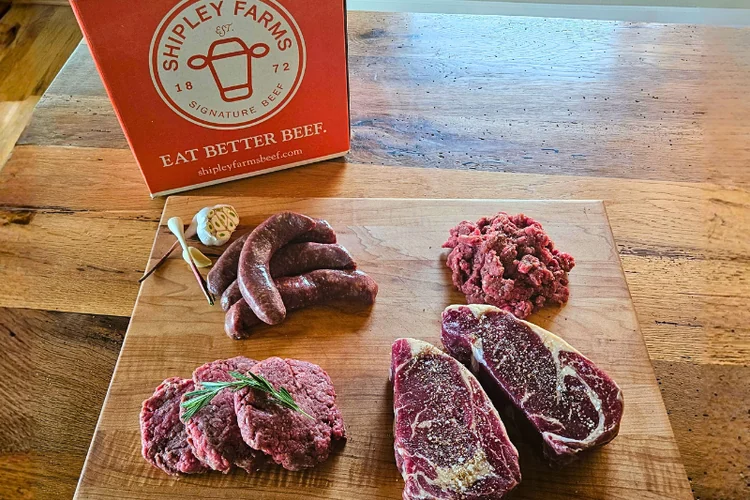
About 175 lbs across 26 cuts. Reserved against a real animal.
View ProductWhat actually happens between ordering a beef share and collecting it?
You reserve a size, we match you to an animal, you choose how it is cut, and you collect it packed and frozen.
- Freezing and Food Safety, USDA FSIS
- Cold Food Storage Chart, FoodSafety.gov
Food-safety temperatures and storage times on this page are cited to the agencies above rather than to us.
Written at Shipley Farms in Vilas, North Carolina: a family cattle farm raising and dry-aging beef in the Appalachian Mountains, now in its fifth generation. No shortcuts since 1872.
Every quote on this page is Gray Shipley talking, the man who runs this farm. We sat down with him, turned on a recorder, and kept his own words. Hesitations are trimmed so they read on the page. Nothing else is added or reworded, except where Gray revised his own words in review.
Nobody knows this beef better than we do. On food safety we leave it to USDA FSIS and FoodSafety.gov, and we have linked their pages above. Reviewed 3 October 2026.
Shipley Farms
Stories, recipes and news from Shipley Farms.