Splitting a Beef Share With Someone Else
Half a half share is how a lot of people start. It works well, and the arguments it causes are always about the same three things.
Splitting a half share between two households is one of the most common ways people buy beef this way, and it is a good idea. It also goes wrong in predictable ways, all of which are solved by a conversation before you order.
Agree these three things first
- Who pays, and when. One person orders and the other reimburses, usually. Decide before, because a share is a real commitment against a real animal.
- Who collects. One vehicle, one freezer, one trip, then divide at home. Far simpler than two people meeting at a pick-up window.
- How the steaks get split. This is the one that causes trouble, and it deserves its own section.
Why the steaks are the problem
A share is not an even mix. Ground beef is the largest part by weight and steaks are the smallest, which is set by the animal rather than by preference. We set out the real proportions in what you get in a half share.
So splitting by weight alone means one household can end up with most of the ground beef and the other with most of the ribeyes, and both feel short-changed.
The method that works
- Split by category, not by total weight. Halve the steaks, halve the roasts, halve the ground, halve the bones. Four splits, not one.
- Alternate picks on anything odd-numbered. Lay the steaks out and take turns. It takes ten minutes and it ends the argument permanently.
- Agree who gets the offal and bones before collection day. Usually one household wants them and the other does not, which makes it easy.
- Divide on a table, not in a freezer. Unpack everything, split it, then both of you pack.
“And I think people enjoy kind of getting to figure out what am I supposed to do with a sirloin tip? What am I supposed to do with a picanha or a tri-tip? I get to go learn and experiment in the kitchen some and figure out how to cook something.”
Gray Shipley
On the cut sheet
Both households live with one cut sheet, so fill it in together. Steak thickness especially: one person wanting inch-and-a-half steaks and the other wanting thin ones cannot both be satisfied from one animal. See how to read a cut sheet.
“Because it's tough for smaller farmers to have something available, 200 pounds ready to go. And we don't know whether you're coming or not. Because if you're not coming, then we still have to find a home for it. And if you are, we have to have it ready.”
Gray Shipley
“Support, they need the community around them to be invested in helping that farm survive and thrive.”
Gray Shipley
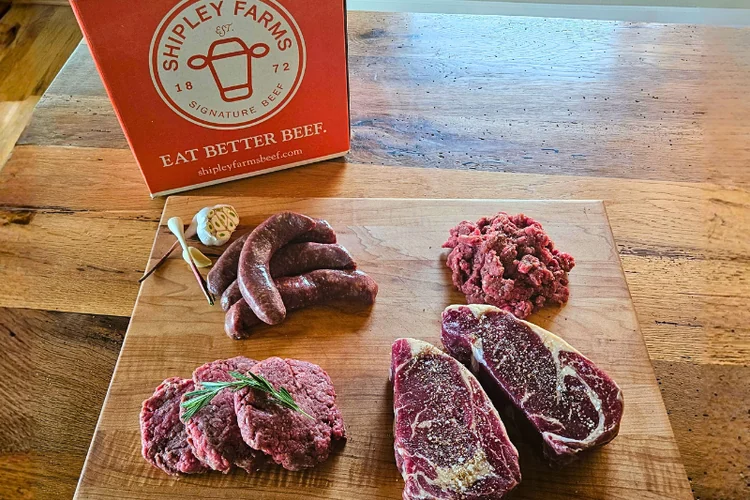
About 175 lbs across 26 cuts, which halves into two sensible freezers.
View ProductCan I split a beef share with another family, and how do we divide it fairly?
Yes. Agree who pays, who collects and how you split the steaks before you order, not after.
- Freezing and Food Safety, USDA FSIS
- Cold Food Storage Chart, FoodSafety.gov
Food-safety temperatures and storage times on this page are cited to the agencies above rather than to us.
Written at Shipley Farms in Vilas, North Carolina: a family cattle farm raising and dry-aging beef in the Appalachian Mountains, now in its fifth generation. No shortcuts since 1872.
Every quote on this page is Gray Shipley talking, the man who runs this farm. We sat down with him, turned on a recorder, and kept his own words. Hesitations are trimmed so they read on the page. Nothing else is added or reworded, except where Gray revised his own words in review.
Nobody knows this beef better than we do. On food safety we leave it to USDA FSIS and FoodSafety.gov, and we have linked their pages above. Reviewed 3 October 2026.
Shipley Farms
Stories, recipes and news from Shipley Farms.