What to Do With Beef Bones
A share comes with bones and most people are not sure what to do with them. They are not interchangeable, and knowing which is which is most of the battle.
Ask for beef bones and you will get whatever is in the freezer. There are really three kinds and they do three different jobs.
Marrow bones
Leg bones, cut into sections. The marrow inside is the product; the bone is packaging. Canoed means split lengthways so the marrow is exposed and can be roasted and scooped out. Cross-cut means sawn into rounds, which look better and are harder to get at.
Broth and stock bones
Knuckle, neck and other joint-heavy bones, which carry a lot of connective tissue. That tissue is the point: it breaks down into gelatin over a long simmer and gives stock its body. A stock made from marrow bones alone is thin, because marrow is fat rather than collagen.
“Well, growing a great carrot has an awful lot that goes into it. And so specialization just allows you to get really good at parts of things, especially on a small scale.”
Gray Shipley
Dog bones
Sold for the purpose, and worth keeping separate in your head. Cooked bones splinter, which is the reason these are sold as a distinct product rather than as a byproduct of dinner.
What to ask for
- Making stock? Ask for knuckle and neck, not marrow.
- Roasting and eating marrow? Ask for canoed leg bones.
- Both? Buy both. They are different products and no single bone does both jobs well.
- Filling in a cut sheet? Claim them explicitly, or they do not come home with you. See how to read a cut sheet.
“Because it's tough for smaller farmers to have something available, 200 pounds ready to go. And we don't know whether you're coming or not. Because if you're not coming, then we still have to find a home for it. And if you are, we have to have it ready.”
Gray Shipley
“Yeah, no shortcuts just means, it's a mindset, the mindset of looking for a shortcut. It doesn't mean that we don't look for improvement. It doesn't mean we don't look for ways to do things better.”
Gray Shipley
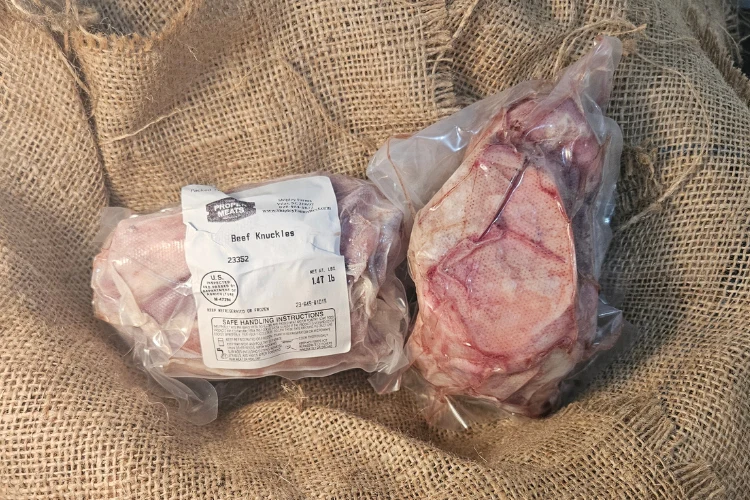
Broth bones, joint-heavy, which is what gives stock body.
View Product
Marrow bones, canoed, so you can actually get at the marrow.
View ProductWhat are beef bones good for and which ones do I want?
Marrow bones for roasting and eating, knuckle and neck bones for stock, and they are different purchases.
- Freezing and Food Safety, USDA FSIS
- Cold Food Storage Chart, FoodSafety.gov
Food-safety temperatures and storage times on this page are cited to the agencies above rather than to us.
Written at Shipley Farms in Vilas, North Carolina: a family cattle farm raising and dry-aging beef in the Appalachian Mountains, now in its fifth generation. No shortcuts since 1872.
Every quote on this page is Gray Shipley talking, the man who runs this farm. We sat down with him, turned on a recorder, and kept his own words. Hesitations are trimmed so they read on the page. Nothing else is added or reworded, except where Gray revised his own words in review.
Nobody knows this beef better than we do. On food safety we leave it to USDA FSIS and FoodSafety.gov, and we have linked their pages above. Reviewed 3 October 2026.
Shipley Farms
Stories, recipes and news from Shipley Farms.