How to Break Down a Whole Strip Loin
A whole strip loin costs substantially less per pound than the steaks cut from it. Here is what you actually have to do.
A whole strip loin is one long muscle. Cutting it into steaks is genuinely easy, and it is the single biggest per-pound saving available on steak.
Five rungs. A long sharp knife matters more than skill.
- 1. Get it cold, and get a long knife
Work with it straight from the fridge, on a board that will not slide. A long slicing knife, not a short one.
You will know it worked when: The meat is firm to press and the knife reaches across the whole width in one stroke.
Most people get this wrong by: Working with it at room temperature, where it flexes and you cannot cut straight.
- 2. Trim the fat cap down, not off
Take the hard outer fat back to about a quarter inch across the top.
You will know it worked when: An even pale layer, no thick lumps, no bare patches.
Most people get this wrong by: Removing it entirely. That fat renders and bastes the steak; bare strip steak dries out.
- 3. Find and remove the side strip
There is a narrow separate muscle along one edge with a seam of gristle. Pull it away and cut it free.
You will know it worked when: A clean single muscle left behind with no visible seam running down the side.
Most people get this wrong by: Leaving it on. It cooks at a different rate and it is chewy.
- 4. Cut even steaks, measuring
Mark your thickness before you cut. An inch and a quarter to an inch and a half for most home cooking.
You will know it worked when: Steaks that stand up on their own and look like each other.
Most people get this wrong by: Eyeballing it. Uneven steaks mean half your pan is done and half is not.
- 5. Trim the tapered ends separately
The ends will not make good steaks. Cube them for skewers or stir-fry.
You will know it worked when: Nothing wasted and no undersized steaks in the pile.
Most people get this wrong by: Cutting thin sad steaks off the ends to make the number go up.
Why it is worth it
You are paying for someone else's knife time, their trim loss and their packaging when you buy steaks individually. Doing it yourself takes about fifteen minutes and you keep the trim, which goes into the grinder or onto skewers.
“You think more farms should adopt knowing your numbers, managing your farm, like a business.”
Gray Shipley
“Farming should adapt or adopt lean practices, learn from the Japanese, look for and eliminate waste. And so that's where technology has its application using technology as tools to find and eliminate waste and bring efficiency.”
Gray Shipley
“That's what farming has to do and needs to do and can do where technology doesn't belong is taking shortcuts and compromising our authenticity. So technology doesn't belong when we're trying to manage and manipulate nature, trying to outsmart God.”
Gray Shipley
The same logic at animal scale is in what a whole beef costs, and the decisions it involves are in how to read a cut sheet.
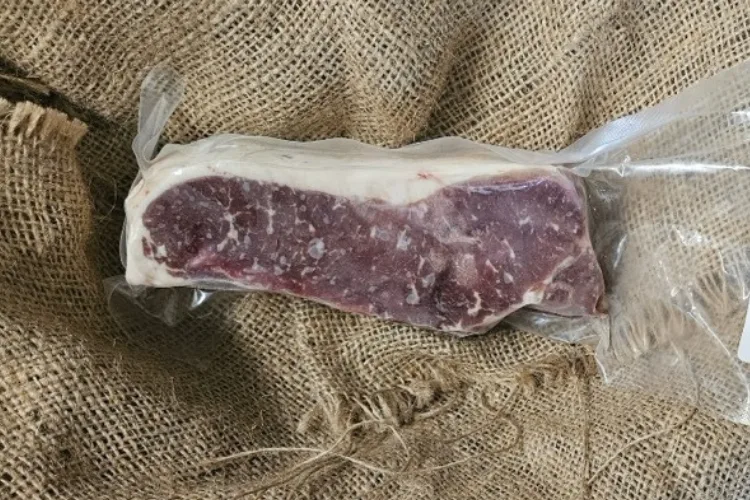
Strip loin, whole and boneless. Fifteen minutes of knife work.
View ProductHow do I cut a whole strip loin into steaks?
Trim the fat cap to about a quarter inch, remove the side strip, and cut even steaks with a long knife.
- Cold Food Storage Chart, FoodSafety.gov
- Refrigeration & Food Safety, USDA FSIS
Food-safety temperatures and storage times on this page are cited to the agencies above rather than to us.
Written at Shipley Farms in Vilas, North Carolina: a family cattle farm raising and dry-aging beef in the Appalachian Mountains, now in its fifth generation. No shortcuts since 1872.
Every quote on this page is Gray Shipley talking, the man who runs this farm. We sat down with him, turned on a recorder, and kept his own words. Hesitations are trimmed so they read on the page. Nothing else is added or reworded, except where Gray revised his own words in review.
Nobody knows this beef better than we do. On food safety we leave it to USDA FSIS and FoodSafety.gov, and we have linked their pages above. Reviewed 3 October 2026.
Shipley Farms
Stories, recipes and news from Shipley Farms.