Why Did My Braise Turn Out Greasy?
A braise that came out slick rather than glossy did not have too much fat in it. The fat went to the wrong place.
Fat in a braise should render out and sit separately, where it can be lifted off or stirred in deliberately. Greasy means it got churned into the liquid instead.
1. It boiled
This is almost always the cause. A rolling boil mechanically emulsifies fat into the liquid, the same way a vinaigrette emulsifies when you whisk it hard. Once that has happened you cannot separate it by skimming.
A braise should barely move. The occasional bubble breaking the surface, no more. Same rule as making stock, and for exactly the same reason.
“And so we're not trying to over manage or overgraze or overproduce or expect the animal to the land to give you more than it's able to give. That's where we err, I think, and thinking, okay, well, I need to get this land to produce more than it actually wants to. So instead of cooperating with nature, people use some stimulant, some chemicals, something to advance it along more than is natural.”
Gray Shipley
2. You did not trim
Hard external fat is different from the intramuscular fat that makes a braise good. Take the thick outer layer off before cooking; leave the marbling alone.
The fix that works every time
Cook it the day before. Chill the whole pot overnight and the fat sets into a solid disc on the surface that lifts off in one piece. Reheat gently. The braise is better the second day anyway, so this costs you nothing.
“If it's the right way, that's what no shortcuts is, we'll put in the extra effort to do things right.”
Gray Shipley
“I like to go with something a little more economical. And so either something like a chuck roast or a sirloin tip, maybe in the crock pot or some short ribs this time of year. Or, I like taking out maybe some skirt steak, some fajita meat, and making some tacos, making some fajitas, getting something that you can just kind of chop up and mix up whatever.”
Gray Shipley
Keep the fat you lift off. It is tallow, and it is the same thing used in roast potatoes.
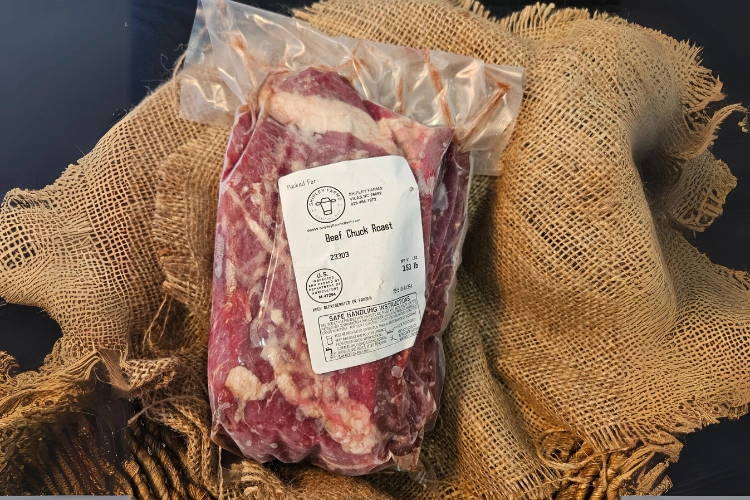
Chuck. Trim the hard outer fat, keep the marbling.
View ProductWhy is my braise greasy?
The fat emulsified into the sauce, usually because it boiled rather than simmered.
- Cook to a Safe Minimum Internal Temperature, FoodSafety.gov
Food-safety temperatures and storage times on this page are cited to the agencies above rather than to us.
Written at Shipley Farms in Vilas, North Carolina: a family cattle farm raising and dry-aging beef in the Appalachian Mountains, now in its fifth generation. No shortcuts since 1872.
Every quote on this page is Gray Shipley talking, the man who runs this farm. We sat down with him, turned on a recorder, and kept his own words. Hesitations are trimmed so they read on the page. Nothing else is added or reworded, except where Gray revised his own words in review.
Nobody knows this beef better than we do. On food safety we leave it to FoodSafety.gov, and we have linked their page above. Reviewed 3 October 2026.
Shipley Farms
Stories, recipes and news from Shipley Farms.