Why We Work With Partner Farms
A straight answer to a question we get asked and that a lot of farm websites dodge: not every animal we sell was raised on our own land.
Here is a question we would rather answer directly than let you assume: is every animal we sell raised on our own land in Vilas? No. We work with sister partner farms, and we think saying that plainly is the only version of this that is consistent with the rest of what we claim.
Why not do all of it ourselves
“Well, growing a great carrot has an awful lot that goes into it. And so, you know, specialization just allows you to get really good at parts of things, especially on a small scale.”
Gray Shipley
A farm that tries to do everything does most of it adequately. At our scale, working with people who are genuinely good at their part is how the standard stays high rather than how it slips.
“You know, the farms that we have access to are just little plot. It's tucked in amongst the hills, you know, and you don't have big large expanses, that you can manage consistently and it's more spread out and it's more disparate. That's what's unique about the farming plus we're in a couple hours off the interstate and kind of tucked up here away from some of the labor pool and some of the resources and some of the transportation that makes it easier to get out and reach customers that are a little further away.”
Gray Shipley
The land up here is also part of it. The farms around us are small plots tucked into hills, not large even expanses. That geography makes partnership the normal way to operate rather than the exception.
How a partner farm is chosen
“Somebody that has the same principles and cares about the same things. And often it's somebody that like us has been doing it for a few generations. And so they've got a legacy that they're holding up just as we are, but not always.”
Gray Shipley
That is the whole test, and it is not a paperwork test. Same principles, same care about the same things, and often the same situation of holding up something a few generations old. We know these farms and we can go and stand on them.
What stays ours
The standard, the finishing, the dry-aging and the cutting. Beef that carries our name is aged in our cold storage and cut here, whatever field it started in. That is the part we are accountable for and the part we do not hand to anyone else.
Why we are telling you
Because the entire argument for buying from a farm rather than a supermarket is that you can find out things you cannot find out otherwise. A farm that implies every animal came off its own back field, when it did not, has given up that argument in exchange for a nicer sentence.
We make the case for direct buying in farm beef against grocery store beef, and it only works if this part is true.
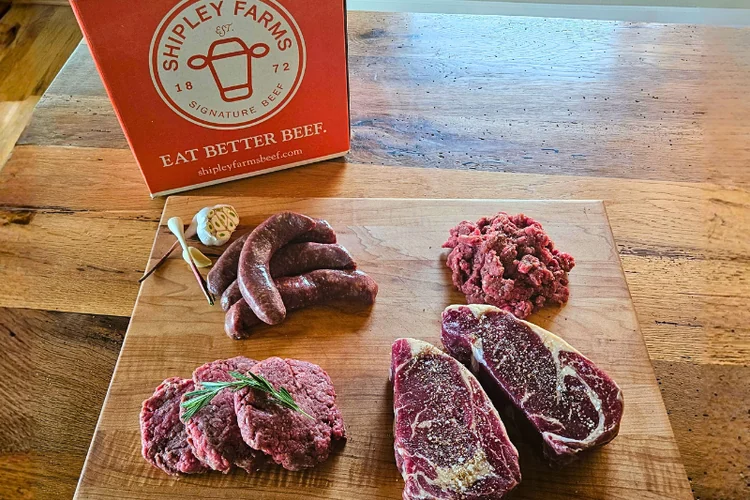
Finished and dry-aged here, whatever field it started in.
View ProductWritten at Shipley Farms in Vilas, North Carolina: a family cattle farm raising and dry-aging beef in the Appalachian Mountains, now in its fifth generation. No shortcuts since 1872.
Every quote on this page is Gray Shipley talking, the man who runs this farm. We sat down with him, turned on a recorder, and kept his own words. Hesitations are trimmed so they read on the page. Nothing else is added or reworded, except where Gray revised his own words in review.
This is a first-hand account rather than guidance. Reviewed 3 October 2026.
Shipley Farms
Stories, recipes and news from Shipley Farms.