Farm Beef vs Grocery Store Beef: What Is Actually Different
Supermarket beef is not bad beef. The differences are real, but they are narrower and more specific than most farm websites will tell you.
Plenty of farm websites will tell you supermarket beef is dangerous or worthless. It is neither, and starting from there makes the rest of the argument untrustworthy. Here are the differences that actually hold up.
What you can find out about the animal
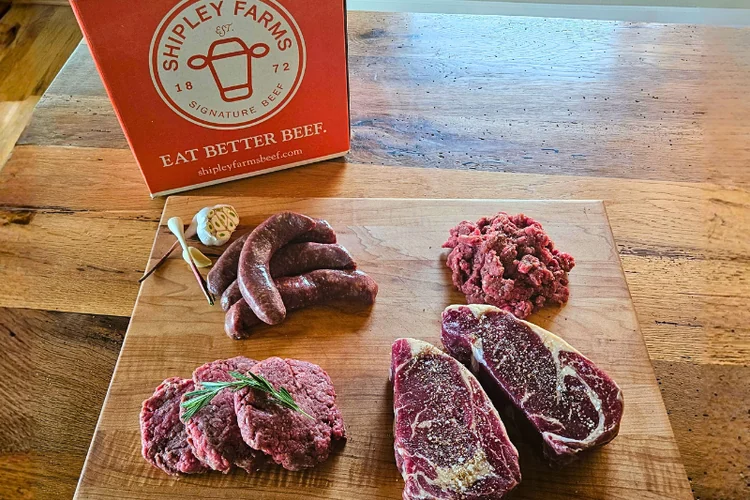
This is the real one. Beef in a supermarket case has usually passed through a feedlot, a large processor and a distributor, and the package tells you a grade and a weight. Beef from a farm store can be traced to a farm, and often to a particular animal and a particular week.
“And so the local food system, one, allows you to know directly where your food's coming from. And two, it's consistently raised and handled and invested in and cared for more responsibly than the industrial system ever could.”
Gray Shipley
Note what that does and does not claim. It is not a claim that industrial beef is unsafe. It is a claim about what you are able to check, and checking is the thing the long supply chain takes away from you.
Aging
Most beef sold in this country is wet-aged, which happens in vacuum packaging during distribution and takes days. Dry-aging hangs the beef in controlled cold air for weeks, which concentrates flavor and lets enzymes work on the connective tissue. It also loses weight to evaporation and ties up cold storage, which is why it costs more and why supermarkets rarely do it. Our guide to dry-aged against wet-aged covers the mechanism.
How the cut was chosen
A supermarket case is stocked to a planogram and a target price point. A farm store is stocked with whatever the animals actually yielded, which is why we sell shares and boxes rather than an endless supply of ribeye. That is a limitation as much as a virtue, and it is worth knowing before you order.
Grades and labels are a separate question
USDA grading assesses marbling and maturity. Labeling terms like natural or grass-fed are defined separately again. Neither system tells you who raised the animal or how, which is the gap that direct buying fills. We cover the vocabulary in beef buying terms, and the agency pages are linked below.
“You know, a certification, really what a certification is you're paying someone else to go tell you what is true. Tell you what is happening somewhere.”
Gray Shipley
That is a fair description of what a certification is and is not. It is a paid attestation, which is useful when you cannot get to the farm, and redundant when you can.
“Yeah, no shortcuts just means, you know, it's a mindset, the mindset of looking for a shortcut. You know, it doesn't mean that we don't look for improvement. It doesn't mean we don't look for ways to do things better.”
Gray Shipley
Where the supermarket wins
Price per pound, convenience, and the ability to buy exactly one steak on a Tuesday. We are not going to beat any of those, and what a share costs says so in figures.
The honest summary
If you want the cheapest adequate beef, buy it at a supermarket. If you want to know whose field it came off and have it aged in a way volume retail cannot justify, buy it from a farm. Both of those are reasonable decisions.
- Grades and Standards: Beef, USDA AMS
- Meat and Poultry Labeling Terms, USDA FSIS
Food-safety temperatures and storage times on this page are cited to the agencies above rather than to us.
Written at Shipley Farms in Vilas, North Carolina: a family cattle farm raising and dry-aging beef in the Appalachian Mountains, now in its fifth generation. No shortcuts since 1872.
Every quote on this page is Gray Shipley talking, the man who runs this farm. We sat down with him, turned on a recorder, and kept his own words. Hesitations are trimmed so they read on the page. Nothing else is added or reworded, except where Gray revised his own words in review.
Nobody knows this beef better than we do. On food safety we leave it to USDA FSIS, and we have linked their pages above. Reviewed 3 October 2026.
Shipley Farms
Stories, recipes and news from Shipley Farms.