What a Beef Share Costs, and Why
A 1/8 share is $825 and a half share is $3,000. People expect buying direct from a farm to undercut the supermarket. It does not, and here is why.
Here is the price list, as it stood on 21 October 2026. We would rather you saw the numbers than filled in a form to get them.
Shares, by size
- 1/8 share. $825, or $905 dry-aged. 40 to 42 lbs across 19 cuts.
- Quarter share. $1,580, or $1,730 dry-aged. About 85 lbs across 23 cuts.
- Half share. $3,000, or $3,250 dry-aged. About 175 lbs across 26 cuts.
Whole animals, priced by hanging weight
A whole beef or a side is not priced as a flat figure, because the animal decides the final weight, not us. A whole beef takes a $750 reservation deposit with the balance billed at $8.75 per hanging pound. A side takes a $500 deposit with the balance at $8.85 per hanging pound.
Hanging weight is the carcass weight before it is cut and trimmed, so the packaged beef you carry home weighs less than the figure you were billed on. Anybody who quotes you a per-pound price without telling you which weight it refers to is not being straight with you.
The thing people expect us to say
“Yeah, sometimes you see that people think it's going to be cheaper. And the logic is, well, hey, we've cut out the middleman, right? If we don't have the distributor, we don't have the transportation, it's not going to Nebraska and back. We should have saved a whole lot of costs.”
Gray Shipley
It is a reasonable expectation. It is also wrong, and we would rather say so plainly than let you work it out after the invoice.
“Yeah, the reality is it costs more because it costs more. It costs more to do things responsibly.”
Gray Shipley
What that means in practice: the animal takes longer to finish on grass, the processing is done in small batches rather than at industrial scale, the dry-aging ties up cold storage for weeks, and nobody in the chain is making the margin back on volume. Those are costs, and they are the costs you are choosing when you buy this way.
“Or, you know, the other side of it is it's the lower quality meat is made cheaper because you're giving up something. You're giving up the authenticity and the quality and the process.”
Gray Shipley
So what are you actually buying
Range, at a known cost, from an animal you can trace. A share is the cheapest way to buy our beef, which is a different claim from being cheaper than beef in general. If per-pound price is the only thing that matters for your household, a supermarket will win and we will not pretend otherwise.
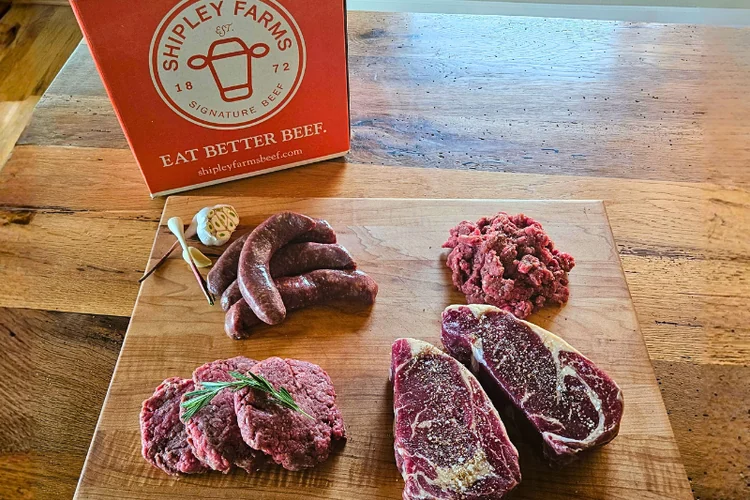
For what arrives, see what you get in a half share. For the comparison itself, see farm beef against grocery store beef.
- Freezing and Food Safety, USDA FSIS
Food-safety temperatures and storage times on this page are cited to the agencies above rather than to us.
Written at Shipley Farms in Vilas, North Carolina: a family cattle farm raising and dry-aging beef in the Appalachian Mountains, now in its fifth generation. No shortcuts since 1872.
Every quote on this page is Gray Shipley talking, the man who runs this farm. We sat down with him, turned on a recorder, and kept his own words. Hesitations are trimmed so they read on the page. Nothing else is added or reworded, except where Gray revised his own words in review.
Nobody knows this beef better than we do. On food safety we leave it to USDA FSIS, and we have linked their page above. Reviewed 3 October 2026.
Shipley Farms
Stories, recipes and news from Shipley Farms.