Beef Buying Terms, Explained
Hanging weight, dry-aged, grass-finished, Prime. Some of these are defined by an agency and some are decoration. Here is which is which.
Beef is sold with a vocabulary that mixes legal definitions, farm practice and pure marketing. Here is a plain reading of the terms you will meet, and a note on which ones are actually defined by somebody other than the seller.
Weights
- Live weight. The animal on the scale. You will rarely be billed on this.
- Hanging weight, or carcass weight. The carcass after harvest, before cutting and trimming. Whole animals and sides are commonly priced per hanging pound. Ours are.
- Take-home weight, or packaged weight. What you actually carry away, after the bones, trim and moisture loss. It is always less than hanging weight, and how much less depends on the animal and on your cut sheet.
If a price is quoted per pound without saying which of these three it refers to, ask. The gap between hanging and take-home is wide enough to change the real cost substantially.
Aging
- Wet-aged. Aged in vacuum packaging, usually during distribution, over days. This is most beef.
- Dry-aged. Hung in controlled cold air for weeks. Concentrates flavor, loses weight to evaporation, costs more to do.
How the animal was raised
- Grass-fed. Describes the diet. Note that cattle eat grass for most of their lives almost everywhere, so on its own this says less than people assume.
- Grass-finished. Describes the last stage before harvest, which is the part that actually differs between systems. This is the more informative term.
- Pasture-raised. Describes where the animal lived. We cover the distinctions in pasture-raised against grass-fed.
“Pasture raised is where the, it's where the animal belongs. They belong on the pasture. And so don't take them out of the environment where they need to be.”
Gray Shipley
Grades
USDA grades, Prime, Choice and Select, assess marbling and maturity. They are a real, consistently applied system, and they say nothing at all about how the animal was raised or by whom. A grade is a measure of one thing, not an overall verdict.
Terms with no fixed meaning
Artisan, premium, farm-fresh, hand-selected and locally sourced are not defined by any agency. They may be entirely true. They are simply not checkable, and a term you cannot check is not evidence.
“Yeah, the reality is it costs more because it costs more. It costs more to do things responsibly.”
Gray Shipley
“You know, a certification, really what a certification is you're paying someone else to go tell you what is true. Tell you what is happening somewhere.”
Gray Shipley
The one question that cuts through all of it
Can you find out who raised the animal, and could you go and look? Every term above describes a property of the beef. That question describes whether anybody is accountable for it.
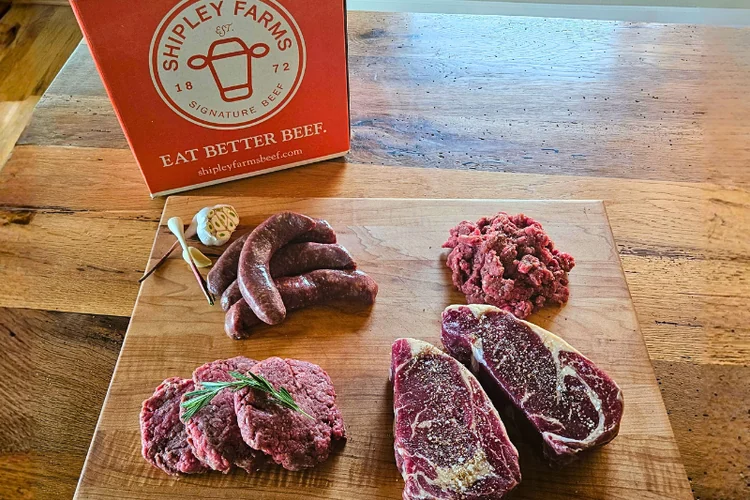
For what those weights translate to in money, see what a beef share costs.
- Grades and Standards: Beef, USDA AMS
- Meat and Poultry Labeling Terms, USDA FSIS
Food-safety temperatures and storage times on this page are cited to the agencies above rather than to us.
Written at Shipley Farms in Vilas, North Carolina: a family cattle farm raising and dry-aging beef in the Appalachian Mountains, now in its fifth generation. No shortcuts since 1872.
Every quote on this page is Gray Shipley talking, the man who runs this farm. We sat down with him, turned on a recorder, and kept his own words. Hesitations are trimmed so they read on the page. Nothing else is added or reworded, except where Gray revised his own words in review.
Nobody knows this beef better than we do. On food safety we leave it to USDA FSIS, and we have linked their pages above. Reviewed 3 October 2026.
Shipley Farms
Stories, recipes and news from Shipley Farms.