Chuck Eye vs Ribeye: Is It Really the Poor Man's Ribeye?
Chuck eye is sold as the poor man's ribeye and for once the nickname is close to accurate. Here is exactly how close.
Most nicknames in the meat business oversell. This one nearly does not.
They are literally the same muscle
The long muscle that runs along the back, the one that produces the ribeye, does not stop at the rib primal. It continues forward into the chuck. The chuck eye is the first few inches of it, on the shoulder side of the dividing line.
The line itself is a butchery convention, not an anatomical boundary. On the rib side it is ribeye and priced accordingly. A couple of inches forward it is chuck and priced like chuck.
“Well, growing a great carrot has an awful lot that goes into it. And so, you know, specialization just allows you to get really good at parts of things, especially on a small scale.”
Gray Shipley
So what actually differs
- Consistency. A ribeye is one clean muscle. A chuck eye sits where several muscles converge, so you get more seams and more variation between steaks.
- Connective tissue. Slightly more on the chuck side, because it is closer to the hard-working shoulder.
- Marbling. Comparable, often genuinely so.
- Price. Substantially different, for the reasons above and because of what the label says.
Cook it the same way
Hot pan, hard sear, pull early, rest. Exactly the method in how to sear a steak. The one adjustment: chuck eye benefits from a slightly longer rest, because those extra seams need a moment to relax.
“Or, you know, the other side of it is it's the lower quality meat is made cheaper because you're giving up something. You're giving up the authenticity and the quality and the process.”
Gray Shipley
“Yeah, no shortcuts just means, you know, it's a mindset, the mindset of looking for a shortcut. You know, it doesn't mean that we don't look for improvement. It doesn't mean we don't look for ways to do things better.”
Gray Shipley
It is also what we recommend as a first order, for exactly this reason: see which cut should you buy first.
The same muscle as a ribeye, on the cheaper side of the line.
View Product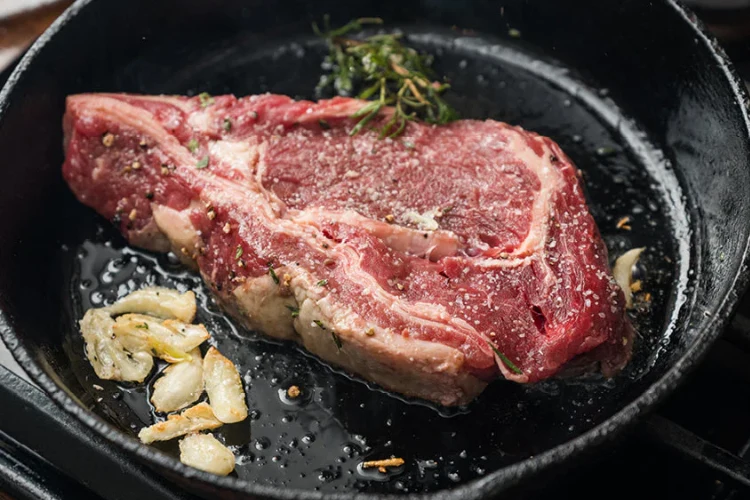
- Cook to a Safe Minimum Internal Temperature, FoodSafety.gov
- Grades and Standards: Beef, USDA AMS
Food-safety temperatures and storage times on this page are cited to the agencies above rather than to us.
Written at Shipley Farms in Vilas, North Carolina: a family cattle farm raising and dry-aging beef in the Appalachian Mountains, now in its fifth generation. No shortcuts since 1872.
Every quote on this page is Gray Shipley talking, the man who runs this farm. We sat down with him, turned on a recorder, and kept his own words. Hesitations are trimmed so they read on the page. Nothing else is added or reworded, except where Gray revised his own words in review.
Nobody knows this beef better than we do. On food safety we leave it to FoodSafety.gov, and we have linked their pages above. Reviewed 3 October 2026.
Shipley Farms
Stories, recipes and news from Shipley Farms.