How to Sear a Steak, One Step at a Time
If you have never seared a steak, this is the whole thing in six steps. Each one tells you what to do, how to know it worked, and what usually goes wrong.
Nobody is born knowing this, and the steps that matter are not the dramatic one. Here is the whole sequence.
Six rungs. Work down them in order.
- 1. Take the steak out of the fridge
Leave it on the counter for 30 to 40 minutes before you cook it.
You will know it worked when: The surface is no longer cold to the back of your hand.
Most people get this wrong by: Going straight from fridge to pan, which gives you a burnt outside and a cold middle.
- 2. Salt it, and let it dry
Salt both sides generously and leave it uncovered while it comes up to temperature.
You will know it worked when: The surface looks matte and dry rather than wet or beaded.
Most people get this wrong by: Salting at the last second, so the surface is still wet and steams instead of browning.
- 3. Get the pan properly hot
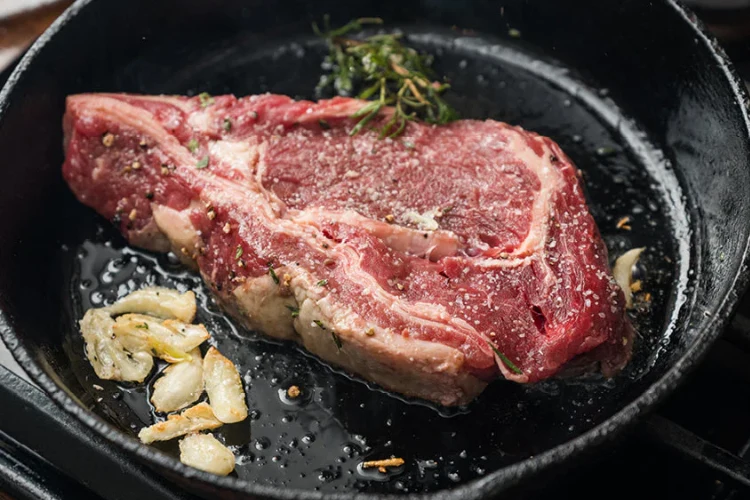
Heat a heavy pan, dry, until a drop of water skitters across it and vanishes.
You will know it worked when: A thread of smoke comes off the pan, not off the oil.
Most people get this wrong by: Starting too cool. Almost every disappointing crust is a pan that was not ready.
- 4. Lay it down and leave it alone
Put the steak down away from you and then do not touch it for about two minutes.
You will know it worked when: It stops sticking and releases on its own when you try to lift a corner.
Most people get this wrong by: Moving it around. Every time you shift it you restart the browning.
- 5. Turn once, then check the middle
Flip it, give it about another two minutes, and start checking with a thermometer.
You will know it worked when: A deep brown crust across the whole face, not gray patches.
Most people get this wrong by: Judging by color alone. The inside and the outside do not report the same thing.
- 6. Pull it early and rest it
Take it off below your target and let it sit for about eight minutes before cutting.
You will know it worked when: The juices settle rather than running out across the board.
Most people get this wrong by: Cutting straight away, which empties the steak onto the board.
Why pull it early
A steak keeps cooking after it leaves the heat. If you wait until the thermometer reads the number you want, you will eat it past that number. The ranges and the carryover figure are in our temperature chart.
“You know, this is one thing that I've never figured out how to crack it to do it really well is meatloaf. If I've got, you know, my grandmother or my mom doing a meatloaf, that's fantastic.”
Gray Shipley
Which is worth remembering the first time it goes wrong. Everyone has a cut they have not cracked yet.
The part that is actually hard
“We used to just kind of not try to outsmart God, let the animal do what it's supposed to do and stay out of the way.”
Gray Shipley
Leaving it alone is the skill. The pan does the work and the cook mostly has to not interfere.
“And it takes three years to make a steak.”
Gray Shipley
If it still came out tough, it is usually the slicing rather than the searing. Why is my steak tough covers the four causes in order.
- Cook to a Safe Minimum Internal Temperature, FoodSafety.gov
- Food Thermometers, USDA FSIS
Food-safety temperatures and storage times on this page are cited to the agencies above rather than to us.
Written at Shipley Farms in Vilas, North Carolina: a family cattle farm raising and dry-aging beef in the Appalachian Mountains, now in its fifth generation. No shortcuts since 1872.
Every quote on this page is Gray Shipley talking, the man who runs this farm. We sat down with him, turned on a recorder, and kept his own words. Hesitations are trimmed so they read on the page. Nothing else is added or reworded, except where Gray revised his own words in review.
Nobody knows this beef better than we do. On food safety we leave it to USDA FSIS and FoodSafety.gov, and we have linked their pages above. Reviewed 3 October 2026.
Shipley Farms
Stories, recipes and news from Shipley Farms.