How to Reverse-Sear a Roast
A roast has to be cooked through evenly and browned hard on the outside. Those want different temperatures, so do them separately.
Searing first and then roasting is the traditional order, and it is backwards. Here is the version that works better on anything thick.
Why do it in reverse
A hot oven browns the outside fast and drives a steep temperature gradient inward, so by the time the center is right the outer inch is overcooked. A low oven moves the whole roast up together, which gives you an even interior and almost no gray band.
But a low oven will not brown anything. So you do that part separately, at the end, in about eight minutes.
The method
- Salt it and leave it uncovered in the fridge overnight if you can. The dry surface matters more here than anywhere.
- Low oven, around 225 to 250, until it is about ten degrees below your target.
- Take it out and let it sit for twenty minutes. It does not need a long rest afterwards, which is the other advantage.
- Oven as hot as it goes, or a very hot pan, for about eight minutes until the outside is deep brown.
- Carve immediately. The rest already happened.
“So, I think that's the most common mistake is you're not sure, so you'll cook it a little longer. And you just don't need to.”
Gray Shipley
The surface has to be dry
“Get the moisture off the surface.”
Gray Shipley
Four words, and they are the whole browning step. A long uncovered rest in the fridge does this for you better than patting with a towel ever will.
“Not as long as I should. Really should go eight to ten minutes. I sometimes barely give it five.”
Gray Shipley
Ranges are in the temperature chart; quantities for a group are in roast beef for a crowd.
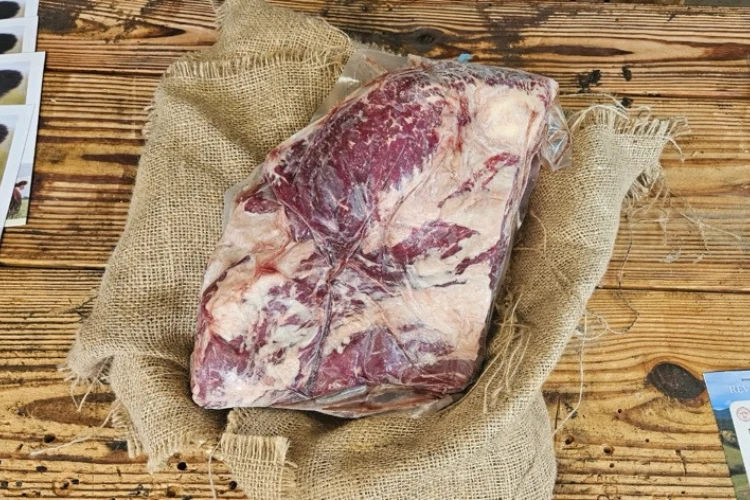
Bone-in standing rib. Reverse-searing suits it better than anything.
View ProductHow do I reverse-sear a beef roast?
Cook it low until it is almost there, then blast the outside at the end.
- Cook to a Safe Minimum Internal Temperature, FoodSafety.gov
- Food Thermometers, USDA FSIS
Food-safety temperatures and storage times on this page are cited to the agencies above rather than to us.
Written at Shipley Farms in Vilas, North Carolina: a family cattle farm raising and dry-aging beef in the Appalachian Mountains, now in its fifth generation. No shortcuts since 1872.
Every quote on this page is Gray Shipley talking, the man who runs this farm. We sat down with him, turned on a recorder, and kept his own words. Hesitations are trimmed so they read on the page. Nothing else is added or reworded, except where Gray revised his own words in review.
Nobody knows this beef better than we do. On food safety we leave it to USDA FSIS and FoodSafety.gov, and we have linked their pages above. Reviewed 3 October 2026.
Shipley Farms
Stories, recipes and news from Shipley Farms.