Demi-Glace in an Instant Pot, From Beef Bones
Demi-glace in an Instant Pot starts the way it always has, with roasted bones, and ends the way it always has, with a slow reduction on the stove. What the pressure cooker changes is the middle. A dark stock that would take most of a day in a stockpot takes about 2 1/2 hours under pressure. Then you reduce it to a glossy, concentrated sauce that coats a spoon, and freeze it in cubes to drop into pan sauces.
A note on names: classic French demi-glace is made from veal bones and finished with a brown sauce. This is a beef version, simpler and darker, made from beef bones and reduced until it is thick and glossy.
At a glance: makes about 1 1/2 to 2 cups. Prep 20 minutes, roast 1 hour, pressure cook 2 1/2 hours plus about 1 hour to come up to and down from pressure, reduce 1 1/2 to 2 hours.
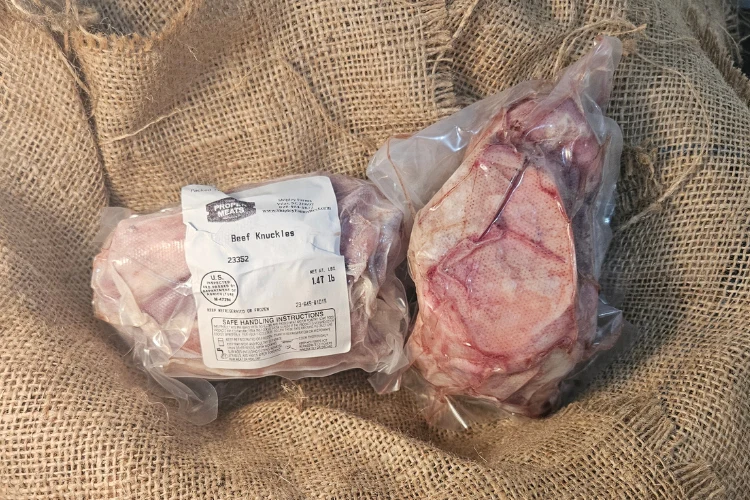
This recipe uses 5 pounds of beef broth bones, sized for an 8-quart pressure cooker.
Add 5 lb beef broth bones to cartView ProductCooking for a full freezer instead? See the 1/8 beef share subscription.
Gray Shipley, who runs the farm, was talking about food that takes time to make:
“The old ways of making food, fermentation, and sourdough bread where you're, you gotta give it time. You gotta use time, make an apple cider vinegar takes time. Some of that you just, there's no substitute for the time that goes into doing something well.”
Gray Shipley
A pressure cooker is a shortcut, and that pulls against his point. It turns a day of simmering into a few hours. What it cannot shorten is the reduction at the end, and that part, watched and stirred on the stove, is where the demi-glace is made.
Ingredients
- 5 pounds beef broth bones
- 3 tablespoons tomato paste
- 2 tablespoons olive oil, divided
- 2 onions, quartered
- 2 carrots, cut into chunks
- 2 celery ribs, cut into chunks
- 1 cup dry red wine, or water
- 1 head garlic, halved crosswise
- 2 bay leaves
- 4 sprigs fresh thyme, or 1 teaspoon dried
- 1 teaspoon black peppercorns
- About 12 cups cold water, to the max line of an 8-quart pot
Instructions
- Heat the oven to 425 degrees. Spread the bones on a large rimmed sheet pan and roast for 30 minutes.
- Stir the tomato paste with 1 tablespoon of the oil and brush it over the tops of the bones. Toss the onions, carrots and celery with the remaining oil and scatter them around the bones. Roast for 25 to 30 minutes more, until the bones are deep brown and the vegetables are browned at the edges. Do not let the tomato paste blacken.
- Move the bones and vegetables into the pressure cooker pot. Pour the wine or water onto the hot sheet pan, scrape up all the browned bits, and pour it into the pot.
- Add the garlic, bay leaves, thyme and peppercorns, then cold water to the max line, and no higher. Lock the lid, set the valve to sealing, and cook at high pressure for 2 1/2 hours.
- Let the pressure come down on its own, 30 to 45 minutes. Strain the stock through a fine-mesh sieve, pressing lightly on the vegetables, then strain it again through a sieve lined with damp cheesecloth or a paper towel. You should have about 10 cups.
- Skim off as much fat as you can with a ladle, or pour the stock through a fat separator. If you have time, chill it overnight instead and lift the fat off in one piece.
- Pour the stock into a wide pan and boil it steadily over medium-high heat, skimming any foam, until it has reduced to about 1 1/2 to 2 cups, 1 1/2 to 2 hours. Turn the heat down as it thickens, and watch it closely for the last 15 minutes.
- It is ready when it coats the back of a spoon and a line drawn through it with your finger holds. Let it cool, pour it into an ice cube tray and freeze it. Pop out the cubes and keep them in a freezer bag.
Add 5 lb beef broth bones to cart
What demi-glace is, and what this version is
In a French kitchen, demi-glace is a rich brown veal stock combined with a brown sauce and reduced by about half, then strained until it is glossy and smooth. It is the base of many classic sauces. Many home cooks make a simpler version: a well-browned stock reduced until it is thick enough to coat a spoon. That is what this is, made with beef bones instead of veal. It is darker and beefier than the classic, and it does the same job in a pan sauce.
Why reduce on the stove, not in the pot
A pressure cooker is sealed, so nothing evaporates. That is what makes it good at extracting a stock and slow at reducing one. You could reduce the stock in the inner pot on the Saute setting, but a wide pan on the stove has far more surface, and the wider the pan, the faster it goes.
How to tell when it is done
Watch the bubbles. As the stock reduces, they get smaller and slower, and the liquid turns from brown to a deep, glossy mahogany. Dip a spoon in and turn it over: it should be coated in an even, shiny layer, and a line drawn through it with your finger should stay clear. Stop there. Taken further, it becomes a sticky glaze that can scorch. If you go too far, loosen it with a splash of water. Either way it will set firm when chilled; it melts again as soon as it warms.
No salt until the end
Do not salt the stock or the reduction. Reducing 10 cups to 2 concentrates everything in it, salt included, and a stock salted to taste becomes far too salty once it is reduced. Season the dish you add it to instead.
Using a 6-quart pot
In a 6-quart pressure cooker, use about 3 pounds of the bones, fill only to the max line, and expect about 1 cup of demi-glace. Freeze the rest of the bones for the next batch.
How to use demi-glace
Sear a steak, pour off the fat, add a splash of wine or water to the pan and scrape it, then drop in a cube or two of demi-glace and swirl in a knob of butter. In a minute you have a sauce. A cube also deepens gravy, stews and braises, and two or three melted with a little stock make a sauce for a roast. Frozen in cubes, it keeps well for a few months.
Food safety
Stock cooked under pressure for hours is far past any FSIS cooking temperature. Cool the demi-glace quickly before you freeze it, and when you use it, heat it until it bubbles. For leftovers you reheat, FSIS gives 165 degrees F. See the FSIS Safe Minimum Internal Temperature Chart.
- Safe Minimum Internal Temperature Chart, USDA FSIS
Food-safety temperatures on this page are cited to USDA FSIS rather than to us.
Published by Shipley Farms. The quote on this page is Gray Shipley, who runs the farm, in his own words from a recorded interview, quoted exactly, or as he revised it in review.
On food safety we follow USDA FSIS, linked above.