Italian Sausage and Broccoli Rabe
Italian sausage and broccoli rabe is one of those pairings that seems obvious once you have tried it. The sausage is rich and seasoned; the rabe is green, a little bitter and full of bite. Blanch the rabe for two minutes in salted water, brown the sausage in coins, and bring them together in a skillet with garlic, chile flakes and olive oil. Toss it all with orecchiette and Pecorino, or serve it without the pasta.
Broccoli rabe, also sold as rapini, looks like a leafy, thin-stemmed broccoli but is a closer relative of the turnip. Cooked straight in oil, it can be sharply bitter. A short blanch takes the edge off and leaves it bright green and tender, and it is the one step in this recipe not to skip.
At a glance: serves 4. Prep 15 minutes, cook about 30 minutes, total about 45 minutes.
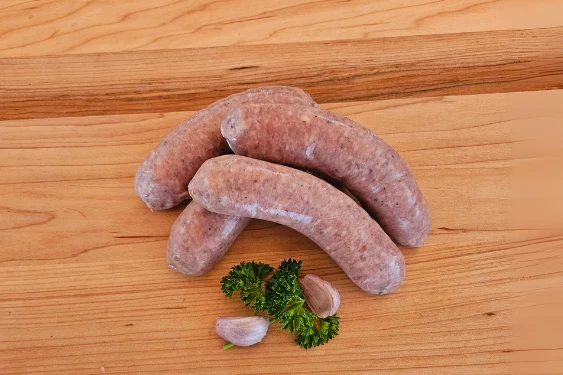
This recipe uses 1 pack of Italian sausage links, sliced into coins and browned.
Add 1 pack of Italian sausage links to cartView ProductWant beef in the freezer too? See the 1/8 beef share subscription.
In a recorded interview, Gray Shipley, who runs the farm, was asked what he says over and over on the farm. Part of his answer was this:
“Always do things the right way.”
Gray Shipley
He was talking about how the farm works, not about dinner. In this dish, though, the right way is the step most quick versions skip: blanching the rabe before it meets the pan. It takes two minutes and the pot of water you were boiling for the pasta anyway, and it is the difference between a pleasant bitterness and a harsh one.
Ingredients
- 1 pack Italian sausage links, about 1 pound
- 1 large bunch broccoli rabe, about 1 1/4 pounds
- 2 tablespoons kosher salt, for the pot
- 12 ounces dried orecchiette
- 1/4 cup olive oil, divided
- 5 cloves garlic, thinly sliced
- 1/2 teaspoon red pepper flakes, or to taste
- 1/2 cup finely grated Pecorino Romano, plus more to serve
- 1 tablespoon fresh lemon juice (optional)
- Freshly ground black pepper, to taste
Instructions
- Bring a large pot of water to a boil and add the kosher salt. While it heats, trim about 1 inch from the ends of the broccoli rabe stems and cut the bunch into 2-inch pieces.
- Add the broccoli rabe to the boiling water and blanch for 2 minutes, until bright green and the stems are just tender. Lift it into a colander with tongs or a slotted spoon, and keep the water boiling for the pasta.
- Slice the sausage links into 1/2-inch coins. Heat 1 tablespoon of the oil in a 12-inch skillet over medium-high heat and add the sausage in a single layer. Cook, turning once, until well browned on both sides and cooked through, 8 to 10 minutes. A thermometer in the thickest piece should read 160 degrees F. Move the sausage to a plate.
- Add the orecchiette to the boiling water and cook until just al dente, usually 11 to 13 minutes; check the package. Before draining, scoop out 1 1/2 cups of the pasta water.
- While the pasta cooks, lower the skillet to medium heat and add the remaining 3 tablespoons of oil, the garlic and the red pepper flakes. Cook, stirring, until the garlic is pale gold, 1 to 2 minutes. Do not let it brown.
- Press the broccoli rabe gently to drain it, add it to the skillet with a pinch of salt, and toss for 2 to 3 minutes to coat it in the garlic oil. Return the sausage and any juices from the plate.
- Add the drained pasta and 1/2 cup of the pasta water and toss over medium heat for 1 to 2 minutes, adding more water a splash at a time until the pasta looks glossy rather than dry.
- Take the pan off the heat, stir in the Pecorino and lemon juice, and season with black pepper. Serve with more Pecorino at the table.
Add 1 pack of Italian sausage links to cart
Why blanch broccoli rabe first
Broccoli rabe is meant to be a little bitter. That is what makes it such a good match for a fatty, seasoned sausage. But raw rabe sauteed straight in oil can be more bitter than most people enjoy, and the thick stems stay tough while the leaves turn to mush. Two minutes in well-salted boiling water softens the stems, seasons the whole bunch, and washes away some of the harshest edge.
If you love the bitterness, cut the blanch to a minute. If you want to get ahead, blanch the rabe up to a day early, cool it in a bowl of ice water, squeeze it gently, and keep it in the fridge. It goes straight into the garlic oil in step 6.
Coins or crumbles?
Slicing the links into coins gives you two flat sides to brown and pieces that hold together when you toss the pasta. Cold sausage slices more neatly than sausage at room temperature, so slice it straight from the fridge. If the coins release a lot of fat, pour some off before the garlic goes in; you want a thin film, not a pool.
For a version where the sausage spreads through every bite, slit the casings, squeeze the meat out, and brown it in small crumbles instead. The cooking time is about the same, and it still needs to reach 160 degrees F. If you are weighing Italian sausage against chorizo for a dish like this, the guides below explain how they differ.
Choosing the pasta
Orecchiette, the little ear-shaped pasta from southern Italy, is the classic choice because each piece cups a bit of garlic oil, a crumb of sausage and a shred of greens. Cavatelli and medium shells do the same job. Rigatoni and penne work fine but leave more of the sauce in the bottom of the bowl.
The pasta water is what turns olive oil and cheese into a sauce. Its starch helps them cling to the pasta instead of pooling. Add it gradually, and stop as soon as everything looks glossy.
Italian sausage and broccoli rabe without pasta
Leave out the orecchiette and you have a side dish or a light main for four. Follow steps 1 to 3 and 5 to 6, then finish with lemon and a little Pecorino. Serve it with crusty bread, spoon it over soft polenta, or pile it onto a toasted roll with a slice of provolone for a sandwich that holds up well at room temperature.
Food safety
USDA FSIS lists 160 degrees F as the safe minimum internal temperature for ground meats, and sausage is ground meat. Check the thickest coin with an instant-read thermometer before the sausage leaves the pan in step 3. Refrigerate leftovers promptly and reheat them to 165 degrees F, with a splash of water to loosen the pasta. See the FSIS Safe Minimum Internal Temperature Chart.
- Safe Minimum Internal Temperature Chart, USDA FSIS
Food-safety temperatures on this page are cited to USDA FSIS rather than to us.
Published by Shipley Farms. The quote on this page is Gray Shipley, who runs the farm, in his own words from a recorded interview, quoted exactly, or as he revised it in review.
On food safety we follow USDA FSIS, linked above.