Beef in a Slow Cooker
A slow cooker is brilliant for exactly one category of beef and actively bad for the rest. The category is not obvious from the price.
People put an expensive lean roast in a slow cooker, get something dry and stringy out, and conclude slow cookers are bad. The slow cooker was fine. The cut was wrong.
What a slow cooker actually does
It holds food at a low temperature for a long time. That is excellent at one specific job: turning collagen into gelatin. It cannot do anything else. It cannot brown, and it cannot add fat to a cut that has none.
Cuts that work
- Chuck. The default and the best. Full method in the Sunday chuck roast.
- Short ribs. More fat again, very forgiving.
- Oxtail. Almost entirely collagen. The slow cooker's ideal case.
- Brisket, shin, neck. All hard-working, all improved by hours.
Cuts that do not
Anything from the loin or the round. Sirloin tip, eye of round, tenderloin. These have little collagen and little fat, so hours of heat has nothing to convert and simply dries them out. That is the mechanism in why is my roast dry.
“I like to go with something a little more economical. And so either something like a chuck roast or a sirloin tip, maybe in the crock pot or some short ribs this time of year. Or, I like taking out maybe some skirt steak, some fajita meat, and making some tacos, making some fajitas, getting something that you can just kind of chop up and mix up whatever.”
Gray Shipley
Brown it first anyway
The one thing worth doing outside the pot. Ten minutes of hard browning in a pan builds flavor the slow cooker will never produce on its own, and it is the difference between a good result and a beige one.
“And I think people enjoy kind of getting to figure out what am I supposed to do with a sirloin tip? What am I supposed to do with a picanha or a tri-tip? I get to go learn and experiment in the kitchen some and figure out how to cook something.”
Gray Shipley
“And so we're not trying to over manage or overgraze or overproduce or expect the animal to the land to give you more than it's able to give. That's where we err, I think, and thinking, okay, well, I need to get this land to produce more than it actually wants to. So instead of cooperating with nature, people use some stimulant, some chemicals, something to advance it along more than is natural.”
Gray Shipley
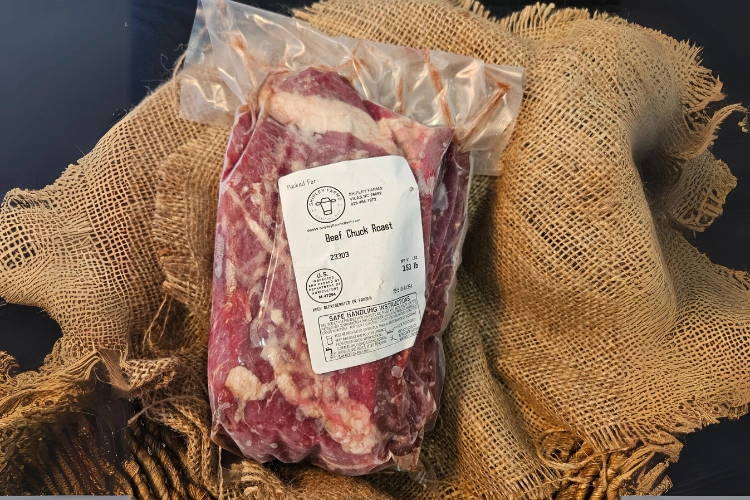
Chuck. Enough collagen that time helps rather than hurts.
View ProductWhich cuts work in a slow cooker and which do not?
Tough, collagen-heavy cuts only. Lean cuts dry out no matter how much liquid is in there.
- Cook to a Safe Minimum Internal Temperature, FoodSafety.gov
- “Danger Zone” (40°F - 140°F), USDA FSIS
Food-safety temperatures and storage times on this page are cited to the agencies above rather than to us.
Written at Shipley Farms in Vilas, North Carolina: a family cattle farm raising and dry-aging beef in the Appalachian Mountains, now in its fifth generation. No shortcuts since 1872.
Every quote on this page is Gray Shipley talking, the man who runs this farm. We sat down with him, turned on a recorder, and kept his own words. Hesitations are trimmed so they read on the page. Nothing else is added or reworded, except where Gray revised his own words in review.
Nobody knows this beef better than we do. On food safety we leave it to USDA FSIS and FoodSafety.gov, and we have linked their pages above. Reviewed 3 October 2026.
Shipley Farms
Stories, recipes and news from Shipley Farms.