Why Is My Roast Dry?
A dry roast feels like you cooked it too long. Usually the opposite is true, and the fix is counterintuitive enough to be worth explaining.
Almost everyone who asks this assumes they cooked it too long. Usually they did not cook it long enough, and that is worth explaining because the fix looks like the mistake.
1. The wrong cut for the method
A lean roast from the round has very little fat and very little collagen. There is nothing in it to melt and keep it moist, so a long cook just dries it out. That cut wants to be roasted fast to a lower doneness and sliced very thin.
A chuck roast is the opposite. Our cut map shows which is which, and the rule is the same one: hard-working cuts have the collagen, lazy ones do not.
2. You pulled a braise too early
This is the counterintuitive one. In a braising cut, collagen only turns to gelatin after hours of low moist heat. Before that happens the meat is tough and tastes dry, no matter how much liquid is in the pot. Pull it at that stage and it is dry because it is underdone.
The fix is to put the lid back on. A fork should turn in it with no resistance. Three hours is a guide; the fork is the test. That is the whole method in the Sunday chuck roast.
“We used to just kind of not try to outsmart God, let the animal do what it's supposed to do and stay out of the way.”
Gray Shipley
3. You rested it out of the liquid
A braised roast should rest in its own liquid, not on a board. On a board it cools and tightens in dry air. In the pot it stays in the environment it just cooked in.
4. You carved it with the grain
Same issue as a steak, and it makes a moist roast eat dry. Find the direction the fibers run and cut across them. Why is my steak tough covers the grain properly.
“You know, this is one thing that I've never figured out how to crack it to do it really well is meatloaf. If I've got, you know, my grandmother or my mom doing a meatloaf, that's fantastic.”
Gray Shipley
“There's a saying that farming isn't rocket science. It's way more complicated than that.”
Gray Shipley
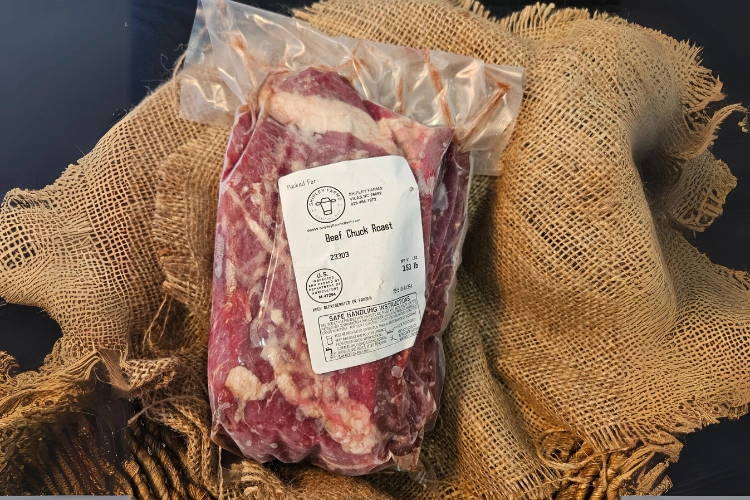
Enough collagen that time helps rather than hurts.
View Product- Cook to a Safe Minimum Internal Temperature, FoodSafety.gov
Food-safety temperatures and storage times on this page are cited to the agencies above rather than to us.
Written at Shipley Farms in Vilas, North Carolina: a family cattle farm raising and dry-aging beef in the Appalachian Mountains, now in its fifth generation. No shortcuts since 1872.
Every quote on this page is Gray Shipley talking, the man who runs this farm. We sat down with him, turned on a recorder, and kept his own words. Hesitations are trimmed so they read on the page. Nothing else is added or reworded, except where Gray revised his own words in review.
Nobody knows this beef better than we do. On food safety we leave it to FoodSafety.gov, and we have linked their page above. Reviewed 3 October 2026.
Shipley Farms
Stories, recipes and news from Shipley Farms.