How Done Is It? A Plain Scale for Beef
Six levels, what each one looks and feels like, and why the color of the meat is the least reliable signal of the three.
People argue about doneness as though it were a matter of taste all the way down. The level you prefer is taste. Knowing which level you are actually at is measurement.
Read with a thermometer in the thickest part, away from bone.
Why color is the worst of the three signals
USDA FSIS is blunt about this: appearance and color are not reliable indicators. Beef can stay pink well past the point you would expect, and it can go gray early. The agency page is linked at the foot of this one, and we have no interest in overriding it.
“You know, a certification, really what a certification is you're paying someone else to go tell you what is true. Tell you what is happening somewhere.”
Gray Shipley
Touch is better, and still not good
The firmness test works, roughly, once you have cooked a few hundred steaks and know what a given cut at a given thickness feels like. It is a skill worth having and a bad place to start. Use it to sanity-check the thermometer, not to replace it.
“There's a saying that farming isn't rocket science. It's way more complicated than that.”
Gray Shipley
The number that actually matters
Not the one on the chart. The one you take the beef off at, which is below it, because carryover finishes the job. The ranges are in our temperature chart and the method is in how to sear a steak.
“Yeah, no shortcuts just means, you know, it's a mindset, the mindset of looking for a shortcut. You know, it doesn't mean that we don't look for improvement. It doesn't mean we don't look for ways to do things better.”
Gray Shipley
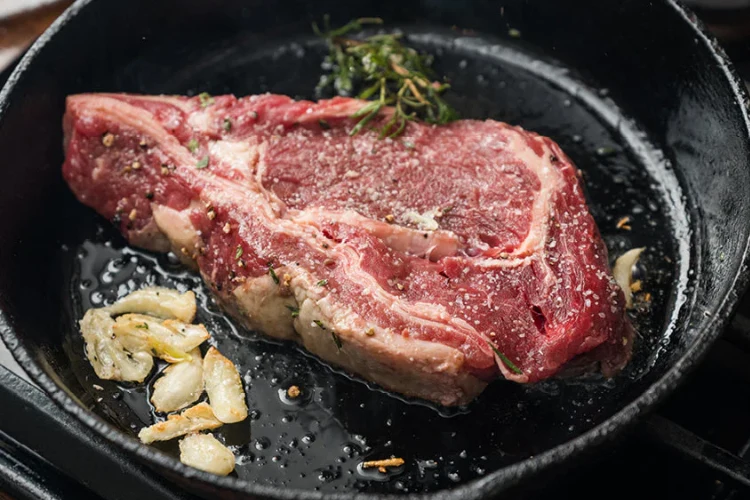
Enough marbling that a level either way still eats well.
View Product- Cook to a Safe Minimum Internal Temperature, FoodSafety.gov
- Doneness Versus Safety, USDA FSIS
- The Color of Meat and Poultry, USDA FSIS
Food-safety temperatures and storage times on this page are cited to the agencies above rather than to us.
Written at Shipley Farms in Vilas, North Carolina: a family cattle farm raising and dry-aging beef in the Appalachian Mountains, now in its fifth generation. No shortcuts since 1872.
Every quote on this page is Gray Shipley talking, the man who runs this farm. We sat down with him, turned on a recorder, and kept his own words. Hesitations are trimmed so they read on the page. Nothing else is added or reworded, except where Gray revised his own words in review.
Nobody knows this beef better than we do. On food safety we leave it to USDA FSIS and FoodSafety.gov, and we have linked their pages above. Reviewed 3 October 2026.
Shipley Farms
Stories, recipes and news from Shipley Farms.