How to Cook Picanha
Picanha arrives with a thick layer of fat on one side. That layer is the entire reason the cut is worth buying, and the method is built around it.
If a butcher offers to trim the fat cap off a picanha, say no. You would be paying for the cut and throwing away the part that makes it work.
Score the cap first
Cut a diamond pattern through the fat, down to but not into the meat. Spacing of about half an inch. This lets the fat render out from the inside rather than just browning on the surface and sealing.
Fat side down, and be patient
Start it in a cold or barely warm dry pan, fat side down, over moderate heat. The fat renders into the pan and the cap gradually browns and crisps. This takes longer than feels right, often eight to ten minutes, and rushing it gives you a soft greasy layer instead of a crisp one.
“We used to just kind of not try to outsmart God, let the animal do what it's supposed to do and stay out of the way.”
Gray Shipley
Then finish it hot
Once the cap is golden and most of the fat has rendered out, turn the heat up and sear the meat side in the fat the cut has just produced. A few minutes is enough. Pull early, as always, and rest it properly.
Slice across the grain, and look first
The grain on a picanha runs across the cut rather than along it, which catches people who slice it like a roast. Cut perpendicular to the fibers, which usually means slicing the short way.
“There's a saying that farming isn't rocket science. It's way more complicated than that.”
Gray Shipley
“Yeah, no shortcuts just means, it's a mindset, the mindset of looking for a shortcut. It doesn't mean that we don't look for improvement. It doesn't mean we don't look for ways to do things better.”
Gray Shipley
How it compares to the cut it is most often confused with is in picanha against tri-tip.
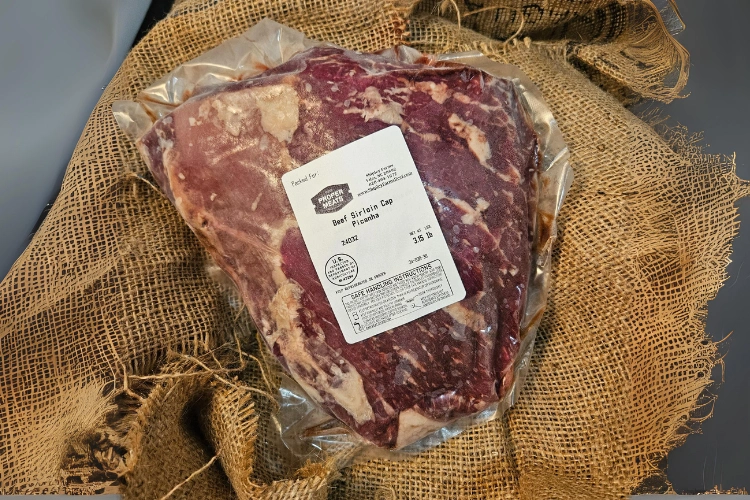
Dry-aged, with the cap left on, which is the whole point.
View ProductHow do I cook a picanha with the fat cap on?
Score the cap, start it fat side down to render, then finish over high heat.
- Cook to a Safe Minimum Internal Temperature, FoodSafety.gov
- Food Thermometers, USDA FSIS
Food-safety temperatures and storage times on this page are cited to the agencies above rather than to us.
Written at Shipley Farms in Vilas, North Carolina: a family cattle farm raising and dry-aging beef in the Appalachian Mountains, now in its fifth generation. No shortcuts since 1872.
Every quote on this page is Gray Shipley talking, the man who runs this farm. We sat down with him, turned on a recorder, and kept his own words. Hesitations are trimmed so they read on the page. Nothing else is added or reworded, except where Gray revised his own words in review.
Nobody knows this beef better than we do. On food safety we leave it to USDA FSIS and FoodSafety.gov, and we have linked their pages above. Reviewed 3 October 2026.
Shipley Farms
Stories, recipes and news from Shipley Farms.