The First Registered Hereford Bull in North Carolina
Around 1897, W.E. Shipley brought the first registered Hereford bull into North Carolina. There was no trailer and no interstate.
It is the kind of family story that sounds embellished until you think about what moving an animal actually involved in 1897.
What that journey meant
There was no stock trailer. There was no road worth the name over those mountains. A registered bull was a significant purchase, and getting one from Virginia into Watauga County meant walking it, at the pace of an animal, behind a wagon, for days.
Nobody does that for a marginal improvement. You do it because you have decided the herd you have is not the herd you want, and you are prepared to spend a week of your life fixing that.
Why Herefords
Herefords suited this country. They handle cold, they do well on rough forage, and they are docile enough to manage on ground where a difficult animal is genuinely dangerous. On slopes like these, temperament is a safety feature.
“Well, our animals use their muscles a little differently and a little more than flatland animals because they're going up and down the hills. And so they're getting a little bit different workout and getting a little bit different utilization of their muscle. And I feel like that contributes a little bit to the uniqueness in the flavor.”
Gray Shipley
The part we are not going to dress up
That heritage Hereford line was discontinued. The herd here today is a Hereford and Angus cross, and we are not going to claim an unbroken line from 1897 to the animals in the field this morning, because it would not be true.
What carried forward is not the bloodline. It is the willingness to go and get the better animal, which shows up again in every generation since.
“Granddad was an early proponent of rotational grazing and, it's now called regenerative agriculture, or adaptive grazing. I've started to use the term redemptive agriculture.”
Gray Shipley
Granddad was an early proponent of rotational grazing long before anybody called it regenerative. Same instinct, different century.
The same decision, made again
“Yeah, quality means we use the term no shortcuts, you know, the way that we've always done it, the way that my granddad and his granddad did it before, there were, you know, chemical genetic modifications.”
Gray Shipley
Walking a bull over a mountain range is the 1897 version of refusing a shortcut. The cost was a week of walking rather than a line on an invoice, but the reasoning is identical: the better animal is worth the inconvenience of going to get it.
Why this matters to a steak
It mostly does not, directly. A cross-bred animal in 2026 does not taste of a bull that walked here in 1897. What it tells you is the length of time this family has been making decisions about cattle on this ground, and that does show up, in the shape of knowing what works on these slopes.
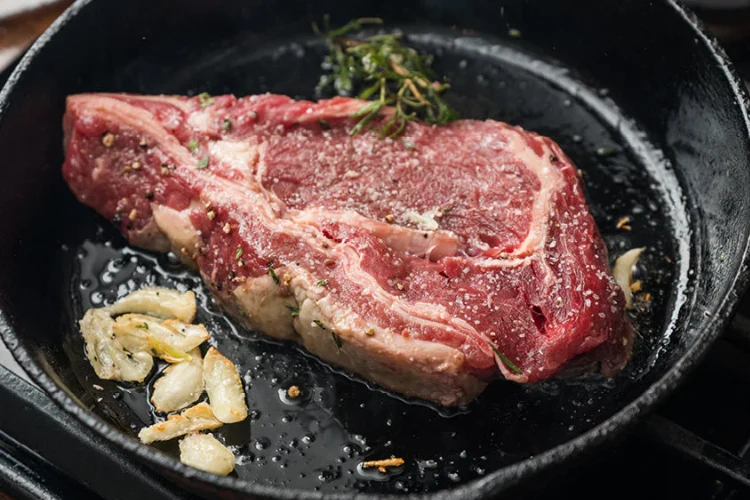
Our signature dry-aged ribeye. Heavily marbled, thick, and forgiving of a minute either way.
View ProductThe full timeline is in Shipley Farms since 1872, and what the mountains do to an animal's muscles is in pasture-raised vs grass-fed.
Written at Shipley Farms in Vilas, North Carolina: a family cattle farm raising and dry-aging beef in the Appalachian Mountains, now in its fifth generation. No shortcuts since 1872.
Every quote on this page is Gray Shipley talking, the man who runs this farm. We sat down with him, turned on a recorder, and kept his own words. Hesitations are trimmed so they read on the page. Nothing else is added or reworded, except where Gray revised his own words in review.
This is a first-hand account rather than guidance. Reviewed 3 October 2026.
Shipley Farms
Stories, recipes and news from Shipley Farms.