Flat Iron Steak in the Oven: Sear, Then Roast
The best way to cook a flat iron steak in the oven is to start it on the stove. Sear both sides in a very hot oven-safe skillet, then move the skillet into a 400 degree oven for a few minutes until the steak reaches temperature. The pan gives you the crust, and the oven cooks the middle evenly without burning the outside. While the steak rests, the same skillet makes a quick pan sauce.
Flat iron is a beef chuck cut. It comes from the top blade muscle of the shoulder. Most chuck cuts are tough and need long, slow cooking, but the top blade is the exception: once the seam of connective tissue that runs through its middle is trimmed out, what is left is a tender, well-marbled steak that cooks quickly.
At a glance: serves 4. Prep 10 minutes, cook about 15 minutes, rest 5 minutes, total 30 minutes.
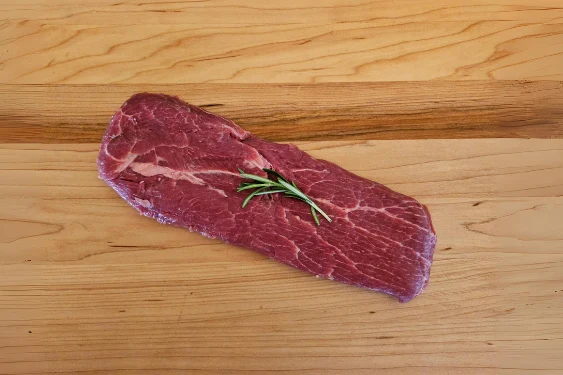
This recipe uses 2 flat iron steaks, about 1 1/2 pounds in all, enough for four.
Add 2 flat iron steaks to cartView ProductCooking for a full freezer instead? See the 1/8 beef share subscription.
Gray Shipley, who runs the farm, was talking about flat iron steak when he said:
“you can grill it, you can pan fry it, and stays tender even if you mess up and overcook it a little bit.”
Gray Shipley
He named the grill and the frying pan, not the oven, and this method is really the pan with help. The skillet makes the crust on the stove, and the oven finishes the steak gently and evenly, which makes it easier to stop at the right moment. You should not need much margin for error, but it is good to know a flat iron gives you some.
Ingredients
- 2 flat iron steaks, 11 to 13 ounces each
- 1 1/2 teaspoons kosher salt
- 1 teaspoon freshly ground black pepper
- 1 tablespoon neutral oil, such as canola or avocado
- 2 tablespoons cold unsalted butter, divided
- 1 small shallot, finely chopped
- 1 clove garlic, finely minced
- 1 teaspoon fresh thyme leaves, or 1/4 teaspoon dried
- 1/2 cup beef stock or broth
- 1 teaspoon Dijon mustard
Instructions
- Set a rack in the middle of the oven and heat it to 400 degrees. Pat the steaks dry and season both sides with the salt and pepper. Let them sit while the oven heats.
- Heat a 10- or 12-inch cast-iron or other oven-safe skillet over medium-high heat for about 5 minutes, until very hot. Add the oil and swirl to coat.
- Lay the steaks in the pan and sear without moving them for 2 to 3 minutes, until deeply browned. Turn them and sear the second side for 2 minutes.
- Move the skillet to the oven and roast for 4 to 8 minutes, until a thermometer in the thickest part reads your target. Start checking at 4 minutes. USDA FSIS sets 145 degrees F with a 3-minute rest as the safe minimum for beef steaks.
- Using an oven mitt, take the skillet out and move the steaks to a cutting board to rest for 5 minutes. Lay a towel over the skillet handle as a reminder that it is hot.
- Pour off all but a thin film of fat and set the skillet over medium heat. Add 1 tablespoon of the butter and the shallot and cook, stirring, for about 1 minute, until soft. Add the garlic and thyme and stir for 30 seconds. Pour in the stock, scrape up the browned bits, and simmer for 2 to 3 minutes, until reduced by about half.
- Take the pan off the heat and whisk in the Dijon, the remaining tablespoon of butter and any juices from the cutting board. Slice the steaks across the grain, spoon the sauce over and serve.
Add 2 flat iron steaks to cart
Why sear first, then roast
An oven on its own is a poor way to brown a steak. Dry heat at 400 degrees takes so long to color the surface that the inside overcooks first. A hot skillet does the browning in a few minutes, and the oven then surrounds the steak with steady heat, so the center cooks evenly with only a narrow gray band under the crust. Heat the oven before you start searing: the steak should go straight from the burner into a hot oven.
How long to cook flat iron steak in the oven
After a sear of 2 to 3 minutes on the first side and 2 on the second, a 1-inch flat iron usually needs 4 to 6 minutes at 400 degrees to reach 145 degrees F, and a 1 1/4-inch steak 6 to 8 minutes. Thinner steaks, around 3/4 inch, may be done by the end of the sear and need no oven time at all. Ovens and pans vary, so treat those times as the point to start checking. An instant-read thermometer pushed into the side of the steak to the center is the only reliable test, and How to Use a Meat Thermometer for Steak shows where to put it.
No oven-safe skillet? Sear the steaks in any heavy pan, then move them to a rimmed sheet pan that has been heating in the oven. The broiler is another route, covered in How to Cook Steak in the Oven, Including Under the Broiler.
A beef chuck flat iron steak recipe, and the rest of the chuck
This recipe works because flat iron behaves like a steak, not like the rest of the shoulder. Chuck roast and stew meat are full of connective tissue and want hours of low, moist heat. The top blade, once its seam is removed, wants the opposite: a short, hot cook, like a strip or a sirloin. Denver steak is another quick-cooking cut from the chuck, and the comparison below explains how the two differ.
The pan sauce is deliberately small. Half a cup of stock, a shallot, a little butter and mustard is enough to coat four servings without drowning a steak that already has plenty of flavor. If you would rather skip it, a spoonful of the resting juices over the sliced steak does almost as well.
Food safety
USDA FSIS lists 145 degrees F, followed by a rest of at least 3 minutes, as the safe minimum internal temperature for beef steaks. Many cooks take flat iron out of the oven at 130 to 135 degrees F for medium rare. That is below the FSIS figure, and the choice is yours. Remember that the skillet handle stays dangerously hot for a long time after it leaves the oven. See the FSIS Safe Minimum Internal Temperature Chart.
- Safe Minimum Internal Temperature Chart, USDA FSIS
Food-safety temperatures on this page are cited to USDA FSIS rather than to us.
Published by Shipley Farms. The quote on this page is Gray Shipley, who runs the farm, in his own words from a recorded interview, quoted exactly, or as he revised it in review.
On food safety we follow USDA FSIS, linked above.