Reverse-Seared Ribeye
A reverse seared ribeye is cooked backward: low and slow first, hot and fast last. Salt a thick ribeye and let it dry in the fridge, bring it up gently in a 250 degree oven until it is 10 to 15 degrees short of where you want it, then sear it for two or three minutes in a smoking-hot cast-iron pan with butter, garlic and thyme. You get an even, rosy center from edge to edge and a deep brown crust, with almost no gray band in between.
The method suits ribeye particularly well. A ribeye is rich with marbling and carries a thick edge of fat, and the long, gentle start warms that fat through so the hot pan can finish rendering it in the time it takes to build the crust.
At a glance: serves 2 to 4. Prep 10 minutes, dry-brine at least 1 hour (overnight is better), cook about 1 hour, rest 5 minutes.
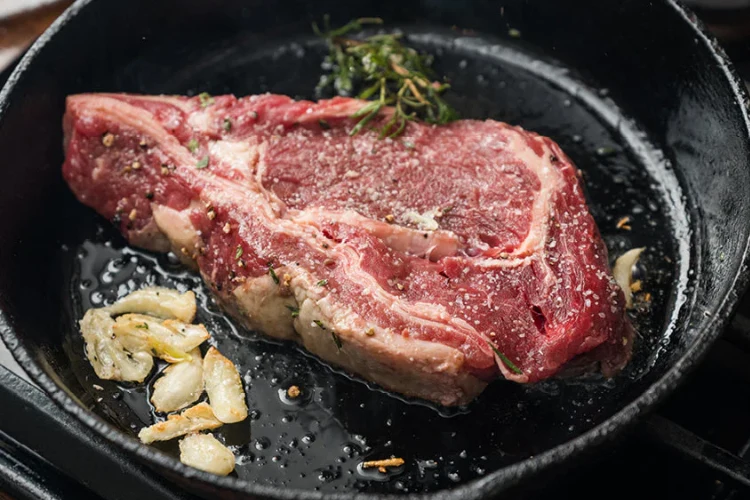
This recipe uses 2 Huston ribeye steaks, one each for two hearty appetites or sliced to share among four.
Add 2 Huston ribeye steaks to cartView ProductCooking for a full freezer instead? See the 1/8 beef share subscription.
Gray Shipley, who runs the farm, was asked for his most reliable steak advice, the one thing not to get wrong. He talked about the surface of the meat:
“Let it dry before you put it on the skillet or put it on the grill so that you get the sear on the outside. You keep that moisture and juiciness on the inside.”
Gray Shipley
The reverse sear is built around that advice. An uncovered rest in the fridge dries the surface, the low oven dries it further, and by the time the steak meets the pan there is almost no water left on it to steam away. The crust forms in a couple of minutes, before the heat has time to push deep into the steak.
Ingredients
- 2 ribeye steaks, about 1 pound each, ideally 1 1/4 to 1 1/2 inches thick
- 2 teaspoons kosher salt
- 1 teaspoon freshly ground black pepper
- 1 tablespoon neutral oil with a high smoke point, such as avocado or canola
- 2 tablespoons unsalted butter
- 3 cloves garlic, lightly crushed
- 4 sprigs fresh thyme or 2 sprigs rosemary
- Flaky salt, to serve (optional)
Instructions
- Pat the steaks dry and season them all over with the kosher salt, edges included. Set them on a wire rack over a rimmed sheet pan and refrigerate, uncovered, for at least 1 hour and up to 24 hours.
- Heat the oven to 250 degrees with a rack in the middle. Season the steaks with the pepper and leave them on the rack and sheet pan. If you have a probe thermometer, push it into the center of the thicker steak from the side.
- Roast until the center is 10 to 15 degrees below your target: about 115 to 120 degrees F for medium rare, 125 to 130 for medium. For 1 1/4- to 1 1/2-inch steaks this usually takes 40 to 55 minutes, but go by the thermometer, not the clock.
- About 10 minutes before the steaks are ready, set a large cast-iron skillet over high heat and let it get very hot, until the oil you add will shimmer and smoke almost at once. Turn on the vent fan.
- Take the steaks out of the oven and blot any moisture from the surface. Add the oil to the skillet, then the steaks. Sear for about 1 minute, flip, and keep flipping every 30 to 60 seconds for 2 to 3 minutes in all, until both sides are deep brown.
- Using tongs, hold each steak on its fat edge against the pan for 30 to 60 seconds to render and brown the fat.
- Lower the heat to medium. Add the butter, garlic and thyme, tilt the pan toward you, and spoon the foaming butter over the steaks for 30 to 60 seconds. Check the temperature again.
- Move the steaks to a cutting board and rest them for 5 minutes. Slice across the grain, spoon the pan butter over the slices, and finish with a little flaky salt.
Add 2 Huston ribeye steaks to cart
Why reverse searing a ribeye works
A thick steak seared first and finished in the oven spends its whole cook with a hot outside and a cooler middle, so it ends up with a wide band of gray, overcooked meat under the crust. Reverse searing a ribeye flips that order. The low oven raises the whole steak slowly and evenly, so by the time it comes out the outside and the center are only a few degrees apart. The sear then only has to brown the surface, which a very hot pan does in two or three minutes.
It works best on thick steaks. Below about 1 inch, there is not enough time in the oven to matter, and a straight sear in a hot pan is simpler. For the general method on other cuts, see the reverse-sear guide below.
Temperatures for reverse searing ribeye
Take the steaks out of the oven 10 to 15 degrees below where you want them to finish, because the sear and the rest will carry them the rest of the way. For medium rare, pull them at 115 to 120 degrees F and they will finish around 130 to 135. For medium, pull at 125 to 130 and finish around 140. Medium rare is below the FSIS figure, and the choice is yours. To meet the FSIS figure, pull the steaks at about 130 degrees F, sear them until the center reads 145 degrees F, and rest them at least 3 minutes.
The fat cap and the ribeye cap
Two things set a ribeye apart from other steaks, and both reward the reverse sear. The first is the strip of fat along one edge. Left alone, it stays pale and chewy; held against the hot pan for half a minute, it turns crisp and golden. The second is the cap, the curved band of meat that wraps around the outside of the main eye, separated from it by a seam of fat. Many cooks think it is the best bite on the whole steak. Because it sits at the edge and is thinner, it cooks a little ahead of the center, and the gentle oven keeps it from overcooking while the eye catches up.
Reverse searing on a grill
The same method works outdoors. Set up a two-zone fire, with the coals or burners on one side only, and cook the steaks on the cool side with the lid down at about 250 degrees until they reach the same pull temperature. Then move them over the hottest part of the fire for a minute or two per side. The guide to cooking a ribeye on the grill or in cast iron below covers both setups.
Food safety
USDA FSIS lists 145 degrees F, followed by a rest of at least 3 minutes, as the safe minimum internal temperature for beef steaks. Check it with an instant-read thermometer in the center of the thickest part. Refrigerate leftovers promptly. See the FSIS Safe Minimum Internal Temperature Chart.
- Safe Minimum Internal Temperature Chart, USDA FSIS
Food-safety temperatures on this page are cited to USDA FSIS rather than to us.
Published by Shipley Farms. The quote on this page is Gray Shipley, who runs the farm, in his own words from a recorded interview, quoted exactly, or as he revised it in review.
On food safety we follow USDA FSIS, linked above.