Smoked Picanha (Sirloin Cap) on a Traeger
A Traeger sirloin cap is one of the easiest big pieces of beef to smoke well. Salt the picanha, smoke it fat side up at 225 degrees until the center is 10 to 15 degrees short of where you want it, then sear the fat cap hard and slice the roast thin across the grain. It takes about an hour and a half on the grill, and any pellet grill will do the same job.
Picanha, also sold as sirloin cap, top sirloin cap or coulotte, is the muscle that sits on top of the top sirloin, under a thick cap of fat. The meat has a big, beefy flavor and a fairly fine grain. Cooked whole and low, the fat keeps the top of the roast moist, and the piece stays thick enough to take on smoke before the center is done.
At a glance: serves 4 to 6. Prep 15 minutes, salt at least 1 hour, smoke 1 to 1 1/2 hours, sear about 10 minutes, rest 10 minutes.
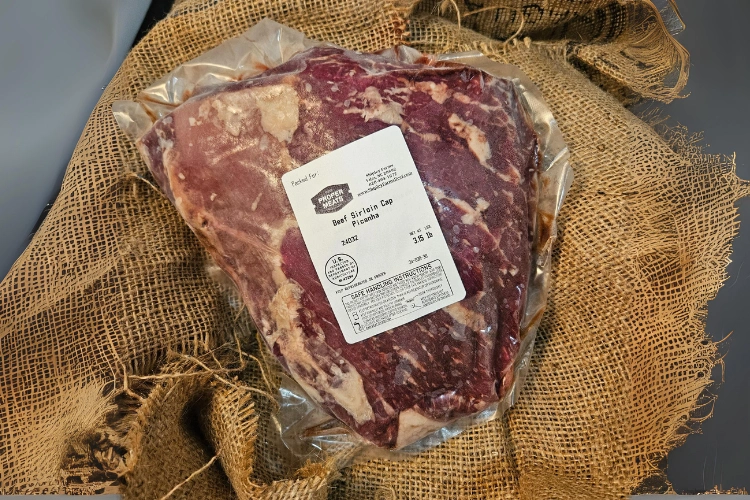
This recipe uses 1 whole picanha, smoked in one piece, which serves four to six.
Add 1 whole picanha to cartView ProductCooking for a full freezer instead? See the 1/8 beef share subscription.
Gray Shipley, who runs the farm, draws a line that matters for this recipe:
“smoking is not the same as adding smoke flavor. It's just, it's just not the same.”
Gray Shipley
A pellet grill smokes the meat: hardwood pellets burn, and the picanha sits in that smoke for an hour or more at a low temperature. A smoky rub or a splash of liquid smoke only adds the flavor. That is why the seasoning here is just coarse salt, with a little pepper and garlic if you like. The smoke and the beef do the rest.
Ingredients
- 1 whole picanha (sirloin cap), 1 1/2 to 2 1/2 pounds, fat cap on
- 2 to 3 teaspoons coarse kosher salt, about 1 teaspoon per pound
- 1 teaspoon coarsely ground black pepper (optional)
- 1/2 teaspoon garlic powder (optional)
- 1 tablespoon neutral oil, such as avocado or canola, if searing in a skillet
- 1/2 teaspoon flaky salt, to serve (optional)
Instructions
- Pat the picanha dry. If the fat cap is thicker than about 1/2 inch, trim it down to that. Score the fat in a shallow crosshatch about 1 inch apart, cutting through the fat but not into the meat.
- Season the picanha all over with the kosher salt, working some into the cuts in the fat, then add the pepper and garlic powder if you are using them. Set it on a rack over a plate and refrigerate it, uncovered, for at least 1 hour and up to 24.
- Fill the hopper with hardwood pellets, such as oak, hickory or a blend, and heat the Traeger or other pellet grill to 225 degrees with the lid closed, about 15 minutes.
- Lay the picanha on the grate fat side up and push a probe thermometer into the thickest part from the side. Close the lid and smoke until the center reads 10 to 15 degrees below your finished target, usually 1 to 1 1/2 hours. For a finish at the FSIS minimum of 145 degrees F, take it off at 130 to 135 degrees F. For medium rare, take it off at 115 to 120 degrees F.
- Move the picanha to a board. Turn the grill to its highest setting, 450 degrees or more, or heat the oil in a large cast-iron skillet over medium-high heat until it shimmers. The meat can wait while the heat comes up.
- Sear the fat side for 3 to 5 minutes, until it is crisp and deep golden, then sear each meat side for about 1 minute. Stay close: rendering fat can flare on a grill and spatter in a pan.
- Rest the picanha on the board for 10 minutes, then check the center again. FSIS asks for 145 degrees F and a rest of at least 3 minutes.
- Cut the roast into two or three pieces where the grain changes direction, then slice each piece across its own grain about 1/4 inch thick. Finish with flaky salt and serve.
Sirloin cap on a Traeger: temperature and time
Set the grill to 225 degrees and leave it there. At that temperature a 2-pound picanha usually needs 1 to 1 1/2 hours to reach about 120 degrees F in the center, but shape matters more than weight: a thick, short roast takes longer than a long, flat one of the same size. Use a probe thermometer and go by the number, not the clock.
Pellets with some strength suit beef. Oak and hickory are good places to start, and a blend works well. Mesquite is strong, so use it in a blend if you like it. Keep the lid closed as much as you can, because every look lets out heat and smoke. If your grill has a setting for extra smoke at low temperatures, this is the cook for it. Nothing here depends on the brand of grill.
Is top sirloin cap the same as picanha?
Yes. Top sirloin cap, sirloin cap, picanha and coulotte are names for the same muscle, the thin cap that sits on top of the top sirloin. Picanha is the Brazilian name, and in Brazil it is often cut into thick steaks, bent into a C shape on a skewer and grilled over charcoal. Coulotte is a name many American butchers use.
For a top sirloin cap on a Traeger, cook it whole rather than as steaks. The bigger piece takes smoke for longer before the center is done, and you keep the whole fat cap for the sear. The guides below cover cooking picanha other ways and how it compares with tri-tip.
Why fat side up, then a hard sear
Fat side up lets the cap soften slowly while the meat underneath smokes, and it keeps the top of the roast from drying out. But fat cooked at 225 degrees stays soft and pale, which is why the sear matters. A few minutes on a very hot surface turns it crisp and browned, and that crisp edge on every slice is a big part of what makes picanha worth cooking.
A cast-iron skillet gives the most even sear, because the whole fat cap sits flat on the hot iron. A pellet grill turned all the way up works too, but it browns more slowly. Give it a few extra minutes on the fat side and watch it closely.
Slicing picanha: the grain changes direction
Look at a cooked picanha from above and you will see the lines of the muscle fan out across the roast. A single straight cut from one end to the other will run with the grain in one place and across it in another. Cut the roast into two or three blocks first, where the grain turns, then slice each block across its own grain. Thin slices, about 1/4 inch, are the most tender. Keep a strip of crisp fat on every slice.
Food safety
USDA FSIS lists 145 degrees F, followed by a rest of at least 3 minutes, as the safe minimum internal temperature for beef roasts and steaks. Many cooks finish picanha at 130 to 135 degrees F for medium rare. That is below the FSIS figure, and the choice is yours. Check the thickest part with an instant-read thermometer after the sear, keep raw meat away from food that will not be cooked, and refrigerate leftovers promptly. See the FSIS Safe Minimum Internal Temperature Chart.
- Safe Minimum Internal Temperature Chart, USDA FSIS
Food-safety temperatures on this page are cited to USDA FSIS rather than to us.
Published by Shipley Farms. The quote on this page is Gray Shipley, who runs the farm, in his own words from a recorded interview, quoted exactly, or as he revised it in review.
On food safety we follow USDA FSIS, linked above.