Sous Vide Picanha
This sous vide picanha recipe gives you an evenly pink roast with a crisp, rendered fat cap. Score the fat, salt the meat, seal it in a bag, and cook it in a water bath at 131 degrees F for medium rare, for 2 to 4 hours. Then dry it well and sear it fat side down in a very hot cast-iron pan until the fat is golden and crisp. Slice it thin across the grain.
Picanha is the cap muscle that sits on top of the top sirloin, with a thick layer of fat on one side. That fat is the point of the cut, and it is why sous vide suits it: the bath cooks the meat evenly with no risk of overshooting, so you can spend the sear on rendering the fat cap instead of worrying about the center.
At a glance: serves 4 to 6. Prep 15 minutes, bath 2 to 4 hours, sear about 10 minutes.
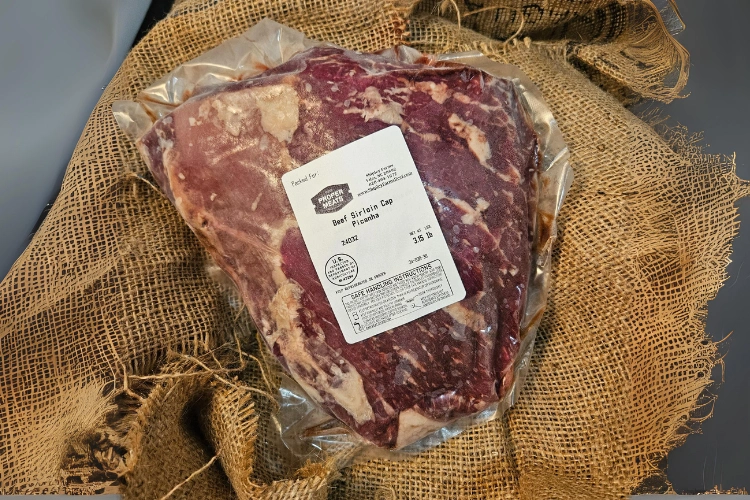
This recipe uses 1 picanha, usually 1 1/2 to 2 1/2 pounds, which serves four to six.
Add 1 picanha to cartView ProductCooking for a full freezer instead? See the 1/8 beef share subscription.
Picanha came up when Gray Shipley, who runs the farm, was talking about people learning to cook cuts they have not met before:
“I think people enjoy kind of getting to figure out what, what am I supposed to do with a sirloin tip? What am I supposed to do with a picanha or a tri-tip?”
Gray Shipley
Sous vide is a gentle way to answer that question the first time you cook one. The water bath sets the doneness for you, so the only real skill left is the sear. Once you know how picanha tastes and slices, the grill and the oven are easy to try next.
Ingredients
- 1 picanha, 1 1/2 to 2 1/2 pounds, with its fat cap
- 1 1/2 to 2 1/2 teaspoons kosher salt, about 1 teaspoon per pound
- 1/2 teaspoon freshly ground black pepper
- 1 tablespoon neutral oil, such as canola or avocado
- Flaky salt, to serve
Instructions
- Fill a container with water, clip in the immersion circulator, and set it to the temperature you want from the table below. 131 degrees F gives medium rare.
- Pat the picanha dry. If there is silverskin on the meat side, trim it off. With a sharp knife, score the fat cap in a crosshatch about 3/4 inch apart, cutting through the fat but not into the meat. Note which way the grain runs on the meat side, so you can find it again after searing.
- Season the picanha all over with the kosher salt and pepper, working some of the salt into the scores.
- Seal it in a vacuum bag, or in a zip-top freezer bag with the air pushed out by lowering it slowly into the water. Cook it in the bath for 2 to 4 hours: at least 2 hours for a picanha about 1 1/2 inches thick at its thickest, and 3 or more for one 2 inches thick or more.
- Take the picanha out of the bag, pat it very dry with paper towels, and let it sit on a rack for 5 minutes so the surface dries further.
- Heat the oil in a cast-iron skillet over medium-high heat until it shimmers. Lay the picanha fat side down and sear it for 4 to 6 minutes, pressing it flat now and then, until the fat is deep golden and crisp. Spoon off some of the rendered fat if it pools. Turn it and sear each of the other sides for 30 to 45 seconds.
- Move it to a board and slice it about 1/4 inch thick across the grain. Sprinkle with flaky salt and serve.
Sous vide picanha temperature
Choose the picanha sous vide temp by the doneness you want on the plate, since a quick sear adds very little to the center. Many cooks like picanha a touch warmer than they would cook a tenderloin, around 131 to 135 degrees F, because the fat running through the meat softens more.
| Doneness | Bath temperature | What you get |
|---|---|---|
| Rare | 125 degrees F | very soft, with the least rendered fat |
| Medium rare | 129 to 131 degrees F | pink and juicy, the usual choice |
| Medium | 135 to 140 degrees F | light pink and firmer |
| FSIS safe minimum | 145 degrees F | little or no pink, firmer still |
Every setting below 145 degrees F is below the FSIS guidance, and the choice is yours.
How long to cook picanha sous vide
Thickness sets the minimum time. The bath has to bring the thickest part of the meat all the way up to temperature, and for most picanha that takes about 2 hours, or closer to 3 for a thick one. Leaving it in for up to 4 hours does no harm. Much past that, the texture starts to turn soft and a little mushy, which is not what you want from this cut.
Searing the fat cap
The bath does nothing for the fat cap, so the sear has to. Start with a very dry surface and a hot pan, fat side down, and give it time: 4 to 6 minutes renders a good part of the fat and turns the rest golden and crisp. The meat sides need only 30 to 45 seconds each, since the inside is already done. You can sear it on a very hot grill instead, fat side down first, but watch for flare-ups. For cooking picanha from raw on the grill or in the oven, see How to Cook Picanha.
Slicing picanha
Slice picanha thin and across the grain. The grain is easy to see on the meat side before you cook it and harder to read after a hard sear, which is why the recipe has you note it at the start. A quick photo on your phone works, or a small notch cut in one corner. Thin slices across the grain are tender. Thick slices along it are chewy, however well the meat was cooked.
Picanha, coulotte and top sirloin cap
Picanha, coulotte and top sirloin cap are names for the same cut: the cap muscle on the top sirloin, sold with its fat on. Picanha vs Top Sirloin: What Is the Difference? explains how it compares with the steak underneath it, and How to Cook Beef Sous Vide has more on cooking other cuts in a water bath.
Food safety
USDA FSIS lists 145 degrees F, followed by a rest of at least 3 minutes, as the safe minimum internal temperature for beef steaks and roasts. A bath set below 145 degrees F, including the 131 degrees F used for medium rare here, is below that guidance, and the choice is yours. Start with a cold picanha straight from the fridge, keep it sealed in the bath, and sear it as soon as it comes out rather than leaving it to sit in a cooling bath. Refrigerate leftovers promptly. See the FSIS Safe Minimum Internal Temperature Chart.
- Safe Minimum Internal Temperature Chart, USDA FSIS
Food-safety temperatures on this page are cited to USDA FSIS rather than to us.
Published by Shipley Farms. The quote on this page is Gray Shipley, who runs the farm, in his own words from a recorded interview, quoted exactly, or as he revised it in review.
On food safety we follow USDA FSIS, linked above.