How to Grill Burgers
A grilled burger is a short cook with very little margin, and almost every failure is self-inflicted: pressing it, flipping it repeatedly, or starting from beef too lean to survive the heat.
A burger on a grill cooks in about eight minutes. There is not much room to correct a mistake, so the method is mostly a list of things not to do.
Start with the right beef
“You don't want a lean burger. You don't want some silly 90-10. You know, get a good 80-20, 75-25 blend.”
Gray Shipley
On a grill this matters more than anywhere else. Fat renders, drips, flares and bastes the patty on its way out. A lean patty has nothing to give and goes from raw to dry with almost nothing in between.
Get the grate properly hot
Clean, hot, and oiled lightly. A burger sticking to the grate is a burger that was put on too early. Give the grill longer than feels necessary and the patty will release on its own when the crust has formed.
The rules
- One flip. Not four. Each flip interrupts the crust forming on the side you just abandoned.
- Never press. Pressing squeezes out the fat you paid for, into the fire, where it does you no good at all.
- Leave the lid alone unless you are melting cheese. Then close it for a minute and no longer.
- Dimple the middle before it goes on, so the patty stays flat instead of doming.
“I like a thicker burger. You know, when you get that sear and the crunch and the smash burger, that's pretty good. But I like a good, thick burger.”
Gray Shipley
A thicker patty is also the more forgiving one on a grill, for the same reason a thick steak is: the middle takes longer to catch up, which buys you time.
When it is done
Pull at about 155 degrees and let it sit two minutes. Carryover takes it to the USDA figure of 160 without drying it out. Color is not a guide here and never has been.
Flare-ups
Fat dripping onto coals is what gives a grilled burger its flavor and what sets fire to it. Keep a cooler zone with nothing under it and move a patty there when the flames come up. Do not squirt water at a fire under food.
The last minute
“And then, you know, let the flavor do the work and don't try to do too much.”
Gray Shipley
Cheese on with a minute left. Buns on the cooler side of the grate for thirty seconds. Everything else belongs on the table rather than on the grill.
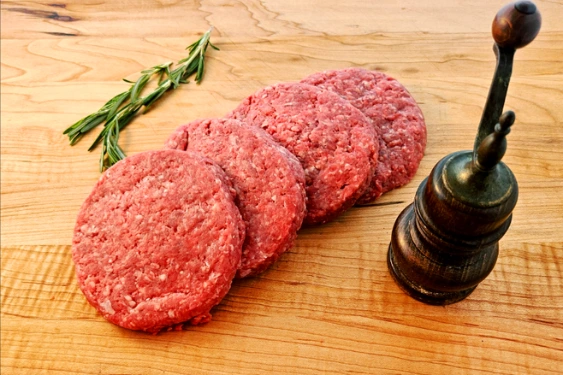
Dry-aged patties at 5.3 ounces, portioned already. Count heads, count patties, done.
View Product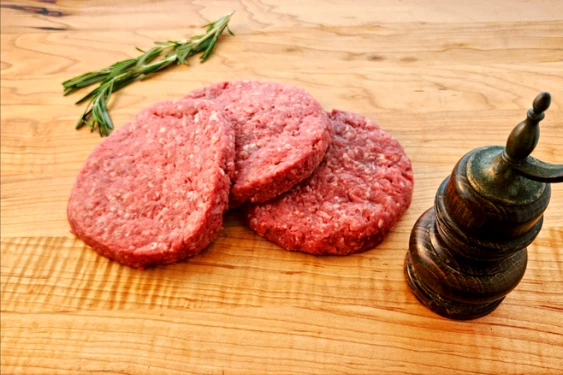
Steakburger patties, ground from the trim off whole steaks rather than from anything left over.
View Product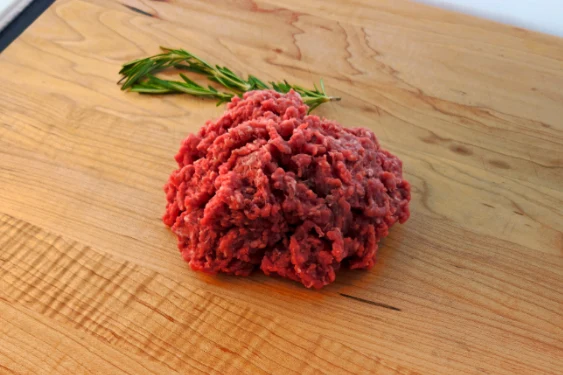
One pound packs of dry-aged ground beef. Four quarter-pounders or three third-pounders to the pack.
View ProductThe temperature question is covered properly in ground beef temperature, the ratio in 80/20 vs 90/10, and if you are feeding a crowd, set up a burger bar.
- Cook to a Safe Minimum Internal Temperature, FoodSafety.gov
- Grilling and Food Safety, USDA FSIS
Food-safety temperatures and storage times on this page are cited to the agencies above rather than to us.
Written at Shipley Farms in Vilas, North Carolina: a family cattle farm raising and dry-aging beef in the Appalachian Mountains, now in its fifth generation. No shortcuts since 1872.
Every quote on this page is Gray Shipley talking, the man who runs this farm. We sat down with him, turned on a recorder, and kept his own words. Hesitations are trimmed so they read on the page. Nothing else is added or reworded, except where Gray revised his own words in review.
Nobody knows this beef better than we do. On food safety we leave it to USDA FSIS and FoodSafety.gov, and we have linked their pages above. Reviewed 3 October 2026.
Shipley Farms
Stories, recipes and news from Shipley Farms.