New York Strip Steak Recipe With Red Wine Pan Sauce
Most New York strip steak recipes come down to the same few steps, and this one adds a sauce that costs you no extra time. Salt the steaks ahead, render the fat cap in a hot cast-iron pan, sear the steaks to temperature, and then make a red wine and shallot pan sauce in the same pan while they rest.
Strip is the steak for people who want a firm, beefy bite without the large pockets of fat in a ribeye. It has a thick band of fat along one edge and a fine, tight grain, and it stands up well to a hard sear. A pan sauce suits it because the browned bits left in the skillet are the best seasoning you have.
At a glance: serves 2 to 4. Prep 10 minutes, salt at least 45 minutes ahead, cook about 25 minutes including the sauce.
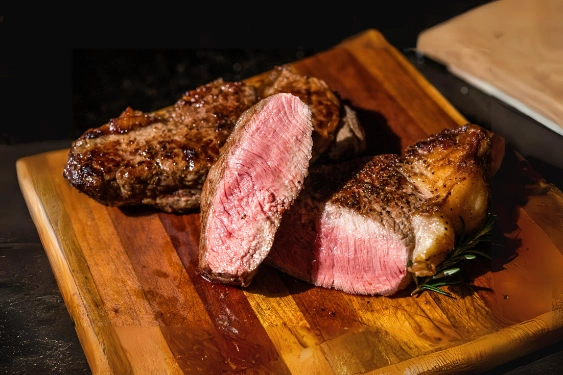
This recipe uses 2 strip steaks: two big plates, or four when sliced and shared.
Add 2 strip steaks to cartView ProductCooking for a full freezer instead? See the 1/8 beef share subscription.
Gray Shipley, who runs the farm, is honest about a step most of us rush. Talking about how long to rest a steak, he said:
“Not as long as I should. Really should go eight to ten minutes. I sometimes barely give it five.”
Gray Shipley
This recipe makes the longer rest easy. The pan sauce takes about 8 minutes from the moment the steaks come out of the pan, so by the time it is glossy and ready, the steaks have had the rest Gray says they really should get.
Ingredients
- 2 New York strip steaks, 1 to 1 1/2 inches thick (3/4 to 1 1/4 pounds each)
- 1 1/2 teaspoons kosher salt
- 1 teaspoon freshly ground black pepper
- 1 tablespoon neutral oil, such as canola or avocado
- 1 large shallot, finely minced (about 1/4 cup)
- 1 clove garlic, minced
- 3/4 cup dry red wine, such as Cabernet Sauvignon or Merlot
- 1/2 cup low-sodium beef stock
- 1 sprig fresh thyme
- 3 tablespoons cold unsalted butter, cut into 3 pieces
Instructions
- At least 45 minutes and up to 24 hours before cooking, season the steaks all over with the salt. Set them on a rack over a plate and refrigerate them, uncovered.
- Pat the steaks dry with paper towels and season them with the pepper. Heat a 12-inch cast-iron skillet over medium-high heat for 5 minutes, then add the oil and heat it until it just begins to smoke.
- Using tongs, stand both steaks on their fat-cap edge in the pan, leaning them against each other. Hold them there for 2 to 3 minutes, until the fat is golden and some of it has melted into the pan.
- Lay the steaks flat and cook for 4 to 5 minutes per side, turning once, until a thermometer in the center reads your target. Many cooks take strip steaks off at 125 to 130 degrees F for medium rare. USDA FSIS sets 145 degrees F with a 3-minute rest as the safe minimum for beef steaks.
- Move the steaks to a cutting board and let them rest for 8 to 10 minutes while you make the sauce.
- Pour off all but about 1 tablespoon of fat and lower the heat to medium. Add the shallot and cook, stirring, until soft, about 1 minute, then add the garlic for 30 seconds.
- Take the pan off the heat and pour in the wine, then set it back over medium-high heat. Add the thyme and simmer, scraping up the browned bits, until the wine has reduced by about two thirds, 3 to 4 minutes. Add the stock and simmer until the sauce has reduced by about half again and looks syrupy, 2 to 3 minutes.
- Take the pan off the heat and remove the thyme. Swirl in the cold butter one piece at a time until the sauce is glossy, then stir in any juices from the cutting board. Taste and add salt if it needs it.
- Slice the steaks across the grain about 1/2 inch thick, or serve them whole, and spoon the sauce over.
Strip steak, strip loin steak or New York strip?
They are the same steak. The strip loin is the long muscle that runs along the back behind the rib, and a steak cut across it is sold as a strip steak, a New York strip, a strip loin steak or a top loin steak, and sometimes, with the bone left on, a Kansas City strip. Any beef strip loin steak recipe works for a New York strip, and the other way round. The only thing that changes the cooking is thickness, so go by a thermometer rather than the clock.
Why start with the fat cap?
A strip has a thick band of fat along one edge. If you only sear the flat sides, that fat stays white and rubbery. Standing the steaks on that edge first melts some of it and browns the rest, and the fat it leaves behind is what the steaks sear in. Tongs, or leaning the two steaks against each other, will hold them upright.
How long to cook a New York strip in cast iron
For steaks about 1 1/4 inches thick, 4 to 5 minutes per side over medium-high heat gets most cooks to medium rare. Thinner steaks need less time and thicker ones more, so check with an instant-read thermometer in the center. Take the steak off about 5 degrees under your target, because the temperature keeps rising as it rests. Medium rare is around 130 to 135 degrees F after resting and medium around 140 degrees F. Both are below the FSIS figure, and the choice is yours. How Long Should Steak Rest? explains why the rest matters.
Making the red wine pan sauce
Use a dry red you would happily drink, nothing sweet. The wine reduces hard, so its character comes through, and a very jammy or oaky bottle makes a heavier sauce. Cold butter is what turns the reduced wine and stock into something glossy, so swirl it in off the heat, a piece at a time. If you would rather not cook with wine, use 1 1/4 cups of beef stock in all, reduce it to about 1/3 cup, and add 1 teaspoon of red wine vinegar before the butter.
More recipes with New York strip
Strip is an easy steak to build a meal around. Grill it over a two-zone fire, which How to Grill a New York Strip Steak walks through step by step. Slice leftovers thin and cold for a steak salad or a sandwich. Serve it with eggs for breakfast, or keep it to salt, pepper and a pat of butter. If you are choosing between strip and its neighbors, Ribeye vs Strip vs Filet compares the three.
Food safety
USDA FSIS lists 145 degrees F, followed by a rest of at least 3 minutes, as the safe minimum internal temperature for beef steaks. Check it with an instant-read thermometer pushed into the center of the steak from the side. Refrigerate leftovers promptly. See the FSIS Safe Minimum Internal Temperature Chart.
- Safe Minimum Internal Temperature Chart, USDA FSIS
Food-safety temperatures on this page are cited to USDA FSIS rather than to us.
Published by Shipley Farms. The quote on this page is Gray Shipley, who runs the farm, in his own words from a recorded interview, quoted exactly, or as he revised it in review.
On food safety we follow USDA FSIS, linked above.