A Thanksgiving Menu for Beginners: Fewer Dishes, Better Food
A Thanksgiving menu for beginners: one roast, three sides, one pie and a four-day plan, from a farmer who cooks for his family.
The best advice for a first Thanksgiving is the hardest to take: cook less.
Gray Shipley cooks as much as anybody when his family gets together. Asked what he would tell somebody hosting for the first time, he started with the ingredients, not the recipes.
“Because great local real food just tastes better, and it's going to shine through without you having to get fancy on it. So, so trust the food and don't get fancy.”
Gray Shipley
Word for word, as recorded
Because great local real food just tastes better and it's going to shine through without you having to get fancy on it so so trust the food and don't get fancy.
Then he named the mistake he says has caused him the most trouble over the years: trying to do too many different things.
“And every additional dish that you prepare is that much more energy divided from all the things that you have to do, and you take a little bit more attention off of each item when you add something, and just increases the risk that things don't come out as good.”
Gray Shipley
Word for word, as recorded
And every additional dish that you prepare is that much more energy divided from all the things that you have to do and you take a little bit more attention off of each item when you add something and just increases the risk that things don't come out as good.
A Thanksgiving menu for beginners
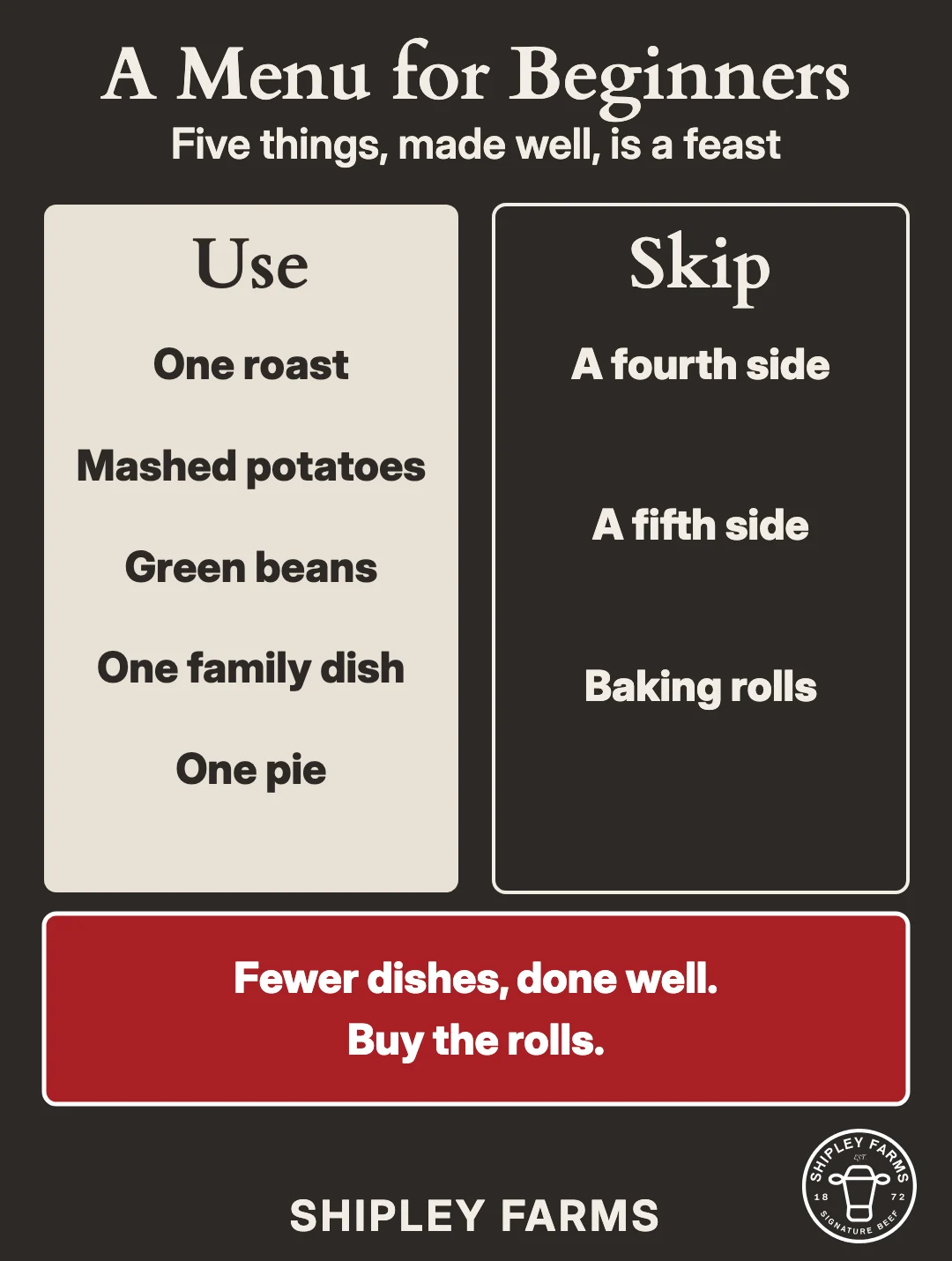
Five things, made well, is a feast. Here is a menu a first-time host can actually finish:
- One roast. Beef is more forgiving than turkey and holds better while people gather. A dry-aged chuck roast is the most relaxed choice, a standing rib roast the most impressive, and a roast ribeye or an eye round roast sits in between. Allow about half a pound per adult for boneless, three quarters for bone-in.
- Mashed potatoes. Make them first and keep them warm in a slow cooker on low.
- One green vegetable. Green beans, roasted or in a casserole.
- One family dish. Whatever your table cannot do without. In the Shipley family it is Grandmother's onions.
- One pie. Bake it the day before. A lard pie crust is the most forgiving dough to roll.
Buy the rolls. Let guests bring the extras, and say yes when they offer.
How many side dishes for Thanksgiving?
Three is plenty for up to ten people. The urge to add a fourth and fifth is the urge Gray warns about. Each one takes a burner, a pan and a slice of your attention at the busiest point of the day.
The four-day plan
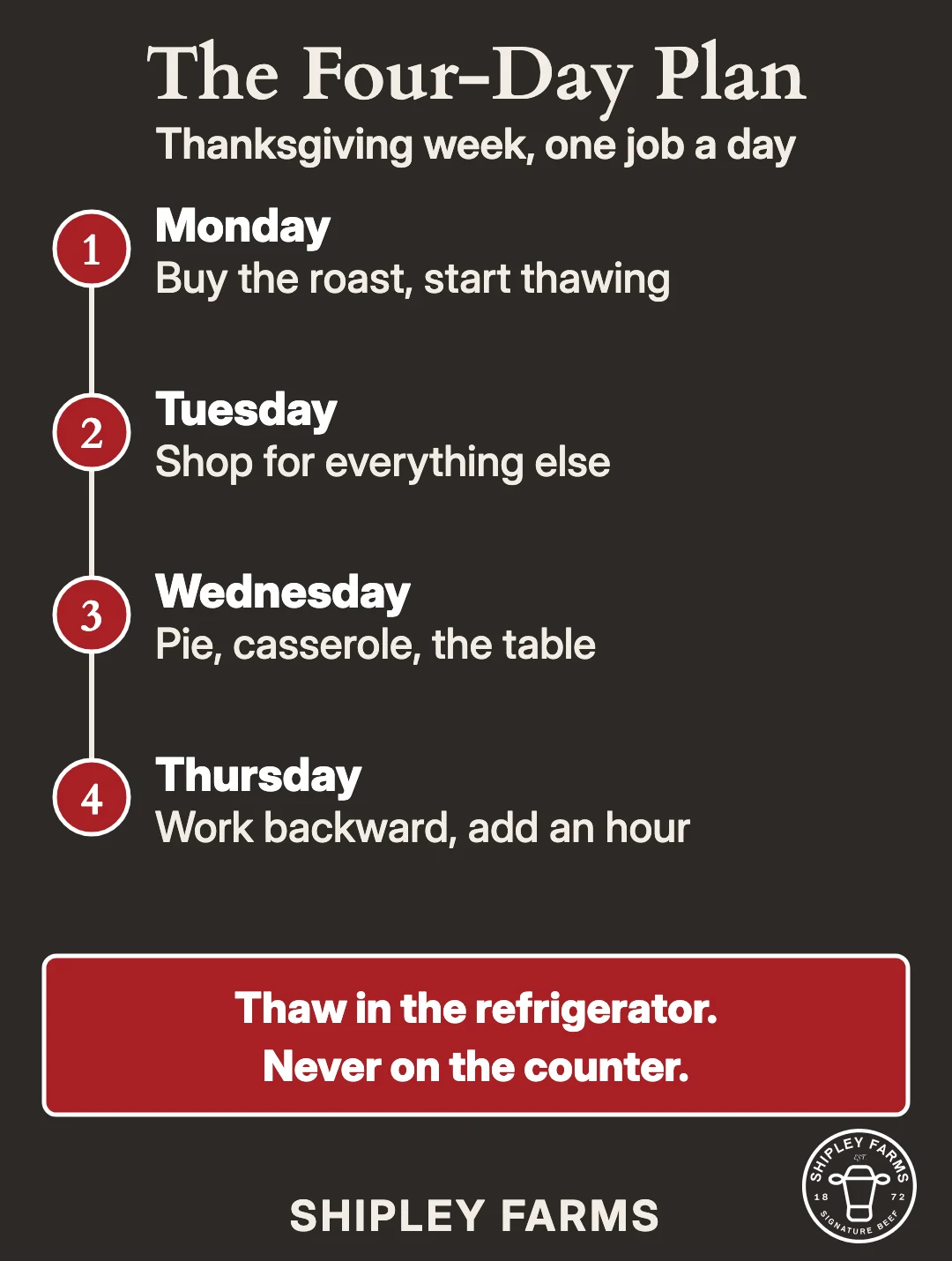
- Monday. Buy the roast. If it is frozen, move it to the refrigerator now. Never thaw it on the counter, and start earlier than you think: a large roast can take more than a day to thaw.
- Tuesday. Shop for everything else. Make a list of every dish with its oven temperature and time, so you can see where they clash.
- Wednesday. The prep day. Bake the pie, make the casserole up to the point of baking, cut the vegetables, set the table.
- Thursday. Work backward from the time you want to eat, then add an hour.
Plan for the meal to start late
Asked about the busiest hour of the week, Gray did not pick a shift at the farm store. He picked this one:
“The busiest hour, the one that can get me a little bit stressed, is that hour before you serve the meal.”
Gray Shipley
Word for word, as recorded
The busiest hour the one that can get me a little bit stressed is that hour before you serve the meal.
And asked what goes wrong every year no matter what he does, he said the meal never starts when it was meant to:
“We never start on time. There's always something that's been sitting too long, there's always something that's not quite ready yet.”
Gray Shipley
Word for word, as recorded
We never start on time there's always something that's been sitting too long there's always something that's not quite ready yet.
So build the meal around dishes that can wait. A roast has to rest anyway: 30 minutes tented with foil, or longer wrapped in towels in a dry cooler, and it will still be hot when people finally sit down. How long to rest beef has the detail. Mashed potatoes hold in the slow cooker. A casserole holds in a low oven. Leave only the gravy and the rolls for the last ten minutes.
Two safety numbers worth knowing
- 145°F is the safe minimum inside a whole cut of beef, with a three-minute rest. Use a thermometer rather than a timer.
- Two hours is how long cooked food can sit out. Get leftovers into the refrigerator within two hours, and eat them within three to four days.
Leftover roast makes the best sandwich of the weekend: a steak sandwich from leftovers shows how to slice and warm it.
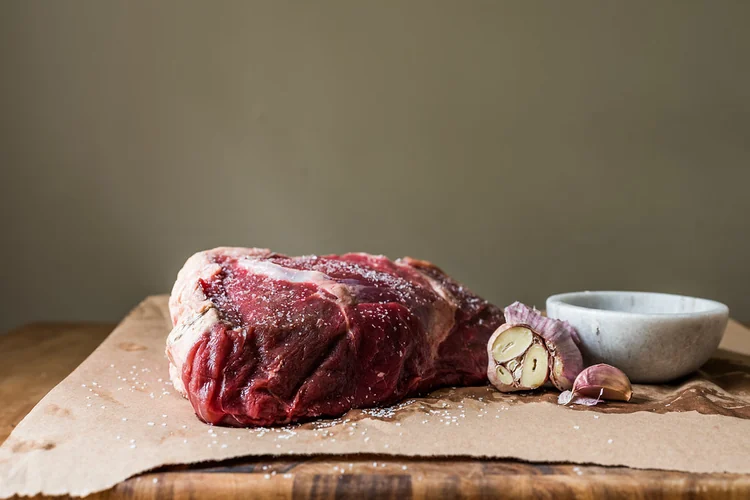
A roast feeds a table and asks very little of you once it is cooking.
View Product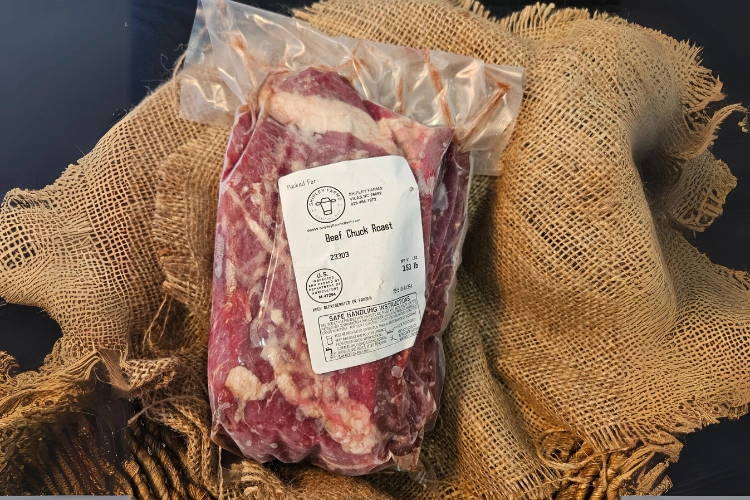
Dry-aged boneless chuck roast. It will not punish a late start or a long rest.
View Product- Cook to a Safe Minimum Internal Temperature, FoodSafety.gov
- Leftovers and Food Safety, USDA FSIS
Food-safety temperatures and storage times on this page are cited to the agencies above rather than to us.
Written at Shipley Farms in Vilas, North Carolina: a family cattle farm raising and dry-aging beef in the Appalachian Mountains, now in its fifth generation. No shortcuts since 1872.
Every quote on this page is Gray Shipley talking, the man who runs this farm. He recorded these answers himself, at the farm, in the autumn of 2026. The play button under each quote is that recording, exactly as he said it, and the words under it are a word-for-word transcript. In the written quotes, hesitations are trimmed so they read on the page. Nothing else is added or reworded, except where Gray revised his own words in review.
On food safety we leave it to USDA FSIS and FoodSafety.gov, and we have linked their pages above. Reviewed 8 November 2026.
Shipley Farms
Stories, recipes and news from Shipley Farms.